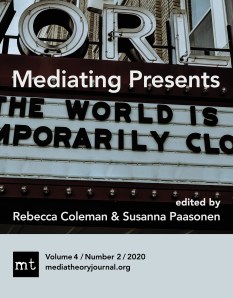
 Mediating Presents, a special issue I coedited with the fantastic Rebecca Coleman, is just out with Media Theory (on open access). As we suggest in our summary, “it is both productive and necessary to think together ‘the present’ and mediation to understand how various interlocking aspects of socio-cultural life are currently produced, organised and arranged, embodied and affectively experienced. The contributions to the special issue see time not as a neutral backdrop to, but as actively constituted by and constitutive of, (digital) media, and develop broad understandings of both media and the temporality of the present/present temporalities. The special issue develops theoretically informed and engaged understandings of digital media presents, drawing from and expanding a range of theoretical traditions, including feminist, queer and anti-racist theory, science and technology studies, media theory, philosophy and cultural theory. They similarly take seriously an array of objects, practices and processes, extending from public and academic debates and figurations, mundane and routinised activities, the affordances of specific platforms and computational and data-driven software.”
Contributors include Xin Liu, Beckie Coleman, Ella Harris, Chris Ingraham, Nishat Awan, Helen Pritchard, Jara Rocha, Femke Snelting and Tony D. Sampson – plus yours truly with Distracted Present, Golden Past? critically examining zeitgeist diagnoses equating networked media with notions of loss.
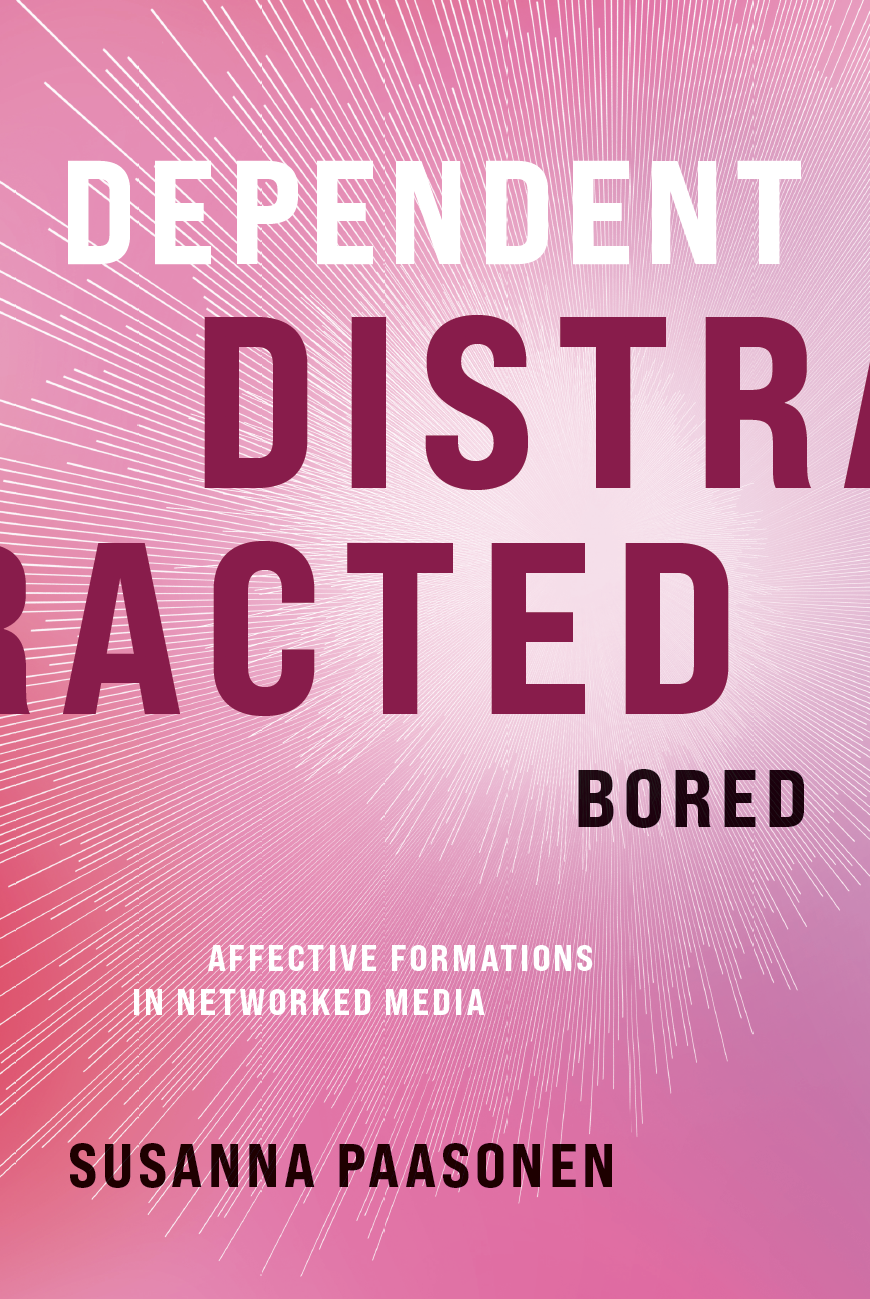 My book a decade in the making is out in April with MIT Press, which makes me very happy. This is a project I started when
  Susanna Paasonen