
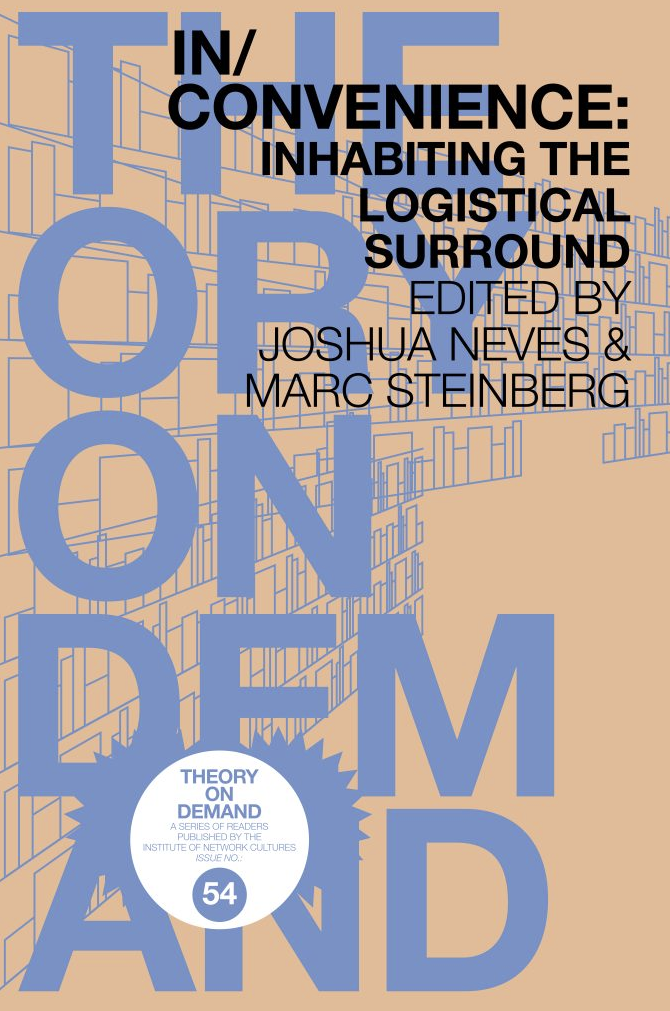
 In/Convenience: Inhabiting the Logistical Surround edited Joshua Neves and Marc Steinberg is out just now with the Insititute of Network Cultures’ Theory on Demand series. The collection covers a lot of ground and also includes my bit, “Platform economies, reputational stains, and the in/conveniences of porn”, a Lauren Berlant-inspired essay on porn’s current financial deplatforming and the moral platform imaginaries that this involves. All on open access!
Category Archives: affect theory
in/conveniences
zoned in and out
 The Routledge Companion to Media Audiences edited by Annette Hill and Peter Lunt is just out, or at least on preorder. The massive whopper includes my bit, titled “Bored audiences: Zoned in and out” which addresses casual gaming as oscillations of interest and boredom in order to consider these concepts on less binary terms. The abstract goes like this:
As affective flatness entailing a sense of stuckness in the present, boredom is routinely cast as the conceptual and experiential opposite of interest indicative of the richness of experience. Taking a different analytical route, this chapter makes an argument for considering boredom and interest in dynamic relation with one another as oscillations in affective intensity. It further calls for adding nuance into what boredom actually means by addressing the dynamics of casual gameplay in the context of the limitations on mobility and stimulus caused by the COVID-19 pandemic lockdowns. Characterised by mass appeal, short play sessions, clear rules, and ease of play, casual games are repetitive, and hence potentially boring, while also routinely used as escapes from boredom, and for filling up time. Starting with conceptualisations of boredom as a modern phenomenon, as the conceptual and experiential opposite of interest indicative of the richness of experience, and as a problem endemic to the attention economies of app culture, this chapter asks what the notion means in the current conjuncture of ubiquitous connectivity and mediated engagement. Through a discussion of casual gaming, it sets out to add nuance to what boredom stands for, and how it becomes diagnosed. Deploying ambiguity as an analytical lens, the chapter then addresses boredom as fluctuating rhythms of experience yielding languor, both pleasurable and very much not.
Filed under academic pleasures, affect theory, cultural studies, media studies
the affect theory reader 2/WTF

The Affect Theory Reader II: Worldings, Tensions, Futures, edited by Gregory J. Seigworth and Carolyn Pedwell for Duke UP, is just out. Quite the whopper, with contributions from Lauren Berlant, Kathleen Stewart, Lisa Blackman, Ann Cvetkovich, Jasbir K. Puar, Erin Manning Adam Frank and Elizabeth A. Wilson, and a whole bunch of others. My piece, titled “Ambiguous affect: excitements that make the self” makes an argument for the critical edge of ambiguity in the context of data culture aiming to aggregate and analyse feeling similarly to any other user data. Writing it, I got very stuck at one point and Greg and Carolyn exemplified academic generosity in helping me become un-stuck. Kudos.
Filed under academic pleasures, affect theory, data culture
interview on affect and ambiguity
The new issue of MAST is out, edited by Tony D. Sampson & Jernej Markelj: it also includes an interview that Jernej and Claudio Celis Bueno did with me, titled “Ambiguity and Affect in Digital Culture“. This took quite a bit of thinking and the kind of retrospection I seldom do: quite the pleasure!
Filed under academic pleasures, affect theory, data culture
experimentations in pandemic boredom
 A new book edited by Britta Timm Knudsen, Mads Krogh and Carsten Stage, titled Methodologies of Affective Experimentation, came out in the summer with Palgrave. Full of insight into things to do with affect in cultural inquiry, it also includes my chapter, “Experimentations in Pandemic Boredom”. It asks how diagnoses of pandemic boredom, and cures thereof, during the COVID-19 lockdowns can help us to rethink broad theoretical takes on boredom identifying it as a modern (Zeitgeist?) phenomenon connected to an abundance of stimuli, or as a state of flatness and disinterest specifically brought forth by networked/social media.
Filed under academic pleasures, affect theory, cultural studies, data culture
technopharmacology is out!
 Co-authored with the excellent Joshua Neves, Aleena Chia and Ravi Sundaram, Technopharmacology is just out with University of Minnesota Press in the In search of media series and as an open access book with Meson Press. The book explores the close relations of media technologies to pharmaceuticals and pharmacology and calls for expanding media theoretical inquiry by attending to the biological, neurological, and pharmacological dimensions of media and centers on emergent affinities between big data and big pharma. My section focuses on diagnoses of online porn addiction and makes an argument for attending to the excitements that make the self. This was fun to make.
Filed under affect theory, data culture, media studies, sexuality
‘I feel the irritation and frustration all over the body’
Our article with Mari Lehto, titled ‘I feel the irritation and frustration all over the body’: Affective ambiguities in networked parenting culture is freshly out with The International Journal of Cultural Studies, on open access. The fieldwork was all Mari’s, and here’s the abstract:
This article investigates the affective power of social media by analysing everyday encounters with parenting content among mothers. Drawing on data composed of diaries of social media use and follow-up interviews with six women, we ask how our study participants make sense of their experiences of parenting content and the affective intensities connected to it. Despite the negativity involved in reading and participating in parenting discussions, the participants find themselves wanting to maintain the very connections that irritate them, or even evoke a sense of failure, as these also yield pleasure, joy and recognition. We suggest that the ambiguities addressed in our research data speak of something broader than the specific experiences of the women in question. We argue that they point to the necessity of focusing on, and working through affective ambiguity in social media research in order to gain fuller understanding of the complex appeal of platforms and exchanges.
dependent, distracted, bored!
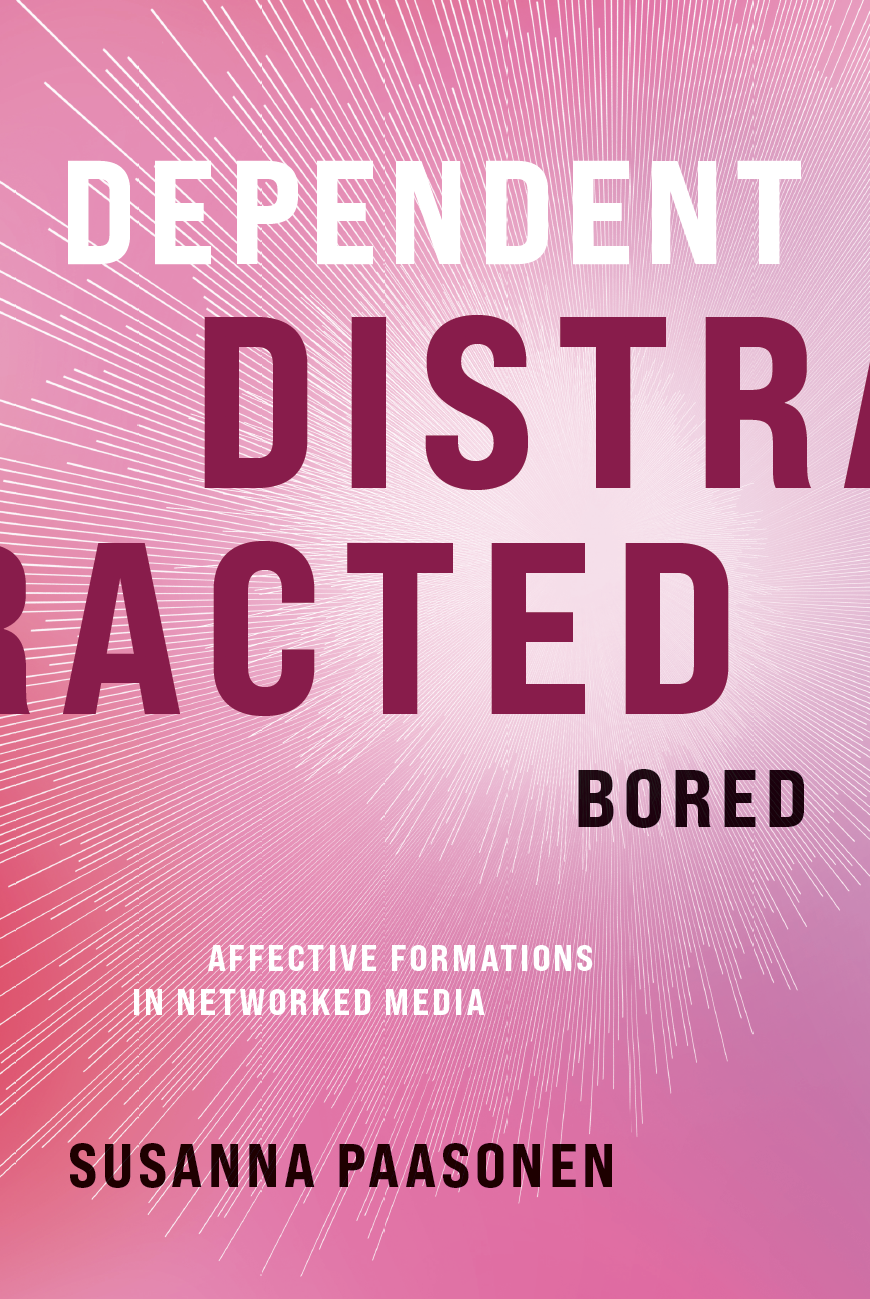 My book very long in the making, Dependent, Distracted, Bored: Affective Formations in Networked Media, is out April 20 with MIT Press. To mark the occasion, I’m doing an IIPC debate talk the day after summing up some of its central themes and points. Join us April 21, 5:15pm EET, at https://utu.zoom.us/j/67932423692. This is the abstract:
According to a dominant narrative repeated in journalistic and academic accounts for more than a decade, we are addicted to the digital devices, apps, and sites designed to distract us, which drive us to boredom and harm our capacities to focus, relate, remember, and be. Focusing on three affective formations — dependence, distraction, and boredom — as key to understanding both the landscape of contemporary networked media and the concerns connected to it, this talk challenges the dominant narrative and argues for the centrality of accounting for complexity and ambiguity instead. Dependence and agency, distraction and attention, boredom and excitement can be seen as dynamics that enmesh, oscillate, enable, and depend on one another — and, in some instances, cannot be told apart.
Filed under academic pleasures, affect theory, data culture, internet research
shameless dicks
A new special issue edited by Gaby David and Amparo Lasén on Shame, Shaming and Online Image Sharing is just out with First Monday, with loads of stuff I’m looking forward to reading. It also includes an article we did with Jenny Sundén, titled Shameless dicks: On male privilege, dick pic scandals, and public exposure. And here’s the abstract:
Academic debates on shame and the involuntary networked circulation of naked pictures have largely focused on instances of hacked accounts of female celebrities, on revenge porn, and interconnected forms of slut-shaming. Meanwhile, dick pics have been predominantly examined as vehicles of sexual harassment within heterosexual contexts. Taking a somewhat different approach, this article examines leaked or otherwise involuntarily exposed dick pics of men of notable social privilege, asking what kinds of media events such leaked data assemble, how penises become sites of public interest and attention, and how these bodies may be able to escape circuits of public shaming. By focusing on high-profile incidents on an international scale during the past decade, this article moves from the leaked shots of male politicians as governance through shaming to body-shaming targeted at Harvey Weinstein, to Jeff Bezos’s refusal to be shamed through his hacked dick pic, and to an accidentally self-published shaft shot of Lars Ohly, a Swedish politician, we examine the agency afforded by social privilege to slide through shame rather than be stuck in it. By building on feminist media studies and affect inquiry, we attend to the specificities of these attempts to shame, their connections to and disconnections from slut-shaming, and the possibilities and spaces offered for laughter within this all.
technology, knowledge & society
The 17th Technology, Knowledge & Society conference, hosted by University of Melbourne and held entirely online, takes place April 8-9, 2021, with the overall theme “Considering Viral Technologies: Pandemic-Driven Opportunities and Challenges”. Very excited about doing a live plenary & garden conversation (8 April 2021 08:00AM CST Chicago // 8 April 2021 16:00PM Finland // 8 April 2021 11:00PM Melbourne) around my soon out book, Dependent, Distracted, Bored: Affective Formations in Networked Media (MITP).
Filed under academic pleasures, affect theory, data culture, internet research
 Susanna Paasonen