Category Archives: cultural studies

affective politics of social media symposium

legoCFP is now out for the Affective Politics of Social Media Symposium held at University of Turku, Finland, October 12-13 2017. Welcome, you all!

Confirmed keynote speakers: Crystal Abidin (Jönköping University / Curtin University), Kath Albury (Swinburne University of Technology), Nancy Baym (Microsoft Research New England), Ken Hillis (UNC Chapel Hill), Ben Light (University of Salford) and Jenny Sundén (Södertörn University).

From clickbaits to fake news, heated Facebook exchanges, viral Twitter messages and Tinder swipes, the landscape of social media is rife with affective intensities of varying speeds and lengths. Affect, as the capacity to relate, impress and be impressed, creates dynamic connections between human and nonhuman bodies. Zooming in on these connections, their intensities, rhythms, and trajectories in the context of networked communications, Affective Politics of Social Media asks how affect circulates, generates value, fuels political action, feeds conflict and reconfigures the categories of gender, sexuality and race through and across social media platforms.

Multiple analytical avenues have already been laid out for doing this, from Jodi Dean’s examination of affect and drive to Tarleton Gillespie’s analysis of the politics of platforms, Adi Kuntsman’s examination of “webs of hate” and Zizi Papacharissi’s discussion of affective publics as contagious articulations of feeling that bring forth more or less temporary sense of community and connection. Building on a growing body of work on “networked affect”, this two-day symposium features keynotes exploring the affective labour of social media influencers, the automation and quantification of the intimate, the netiquette of hook-up apps and the dynamics of music stardom and fandom, and invites contributions connected to affect and social media in relation to

• collective action and political activism
• sexual cultures and practices
• harassment, hate and resistance
• affective rhythms, intensities and investments
• popular culture and everyday life

In order to facilitate participation, the symposium has no registration fee but pre-registrations are required. To propose a paper, please send a 300-word abstract and short bio (max. 100 words) to affective@utu.fi by June 9, 2017. Registrations will be made available in August 2017.

Organized by Department of Media Studies, IIPC, the International Institute for Popular Culture & DIGIN, Research Network on Digital Interaction at University of Turku and the Department of Gender Studies at Åbo Akademi University

Conference website: https://affectivesome.wordpress.com/

Organizing group: Susanna Paasonen, Kaisu Hynnä, Katariina Kyrölä, Mari Lehto, Mari Pajala & Valo Vähäpassi

Leave a comment

Filed under affect theory, cultural studies, internet research, media studies, sexuality

conference season

Late spring turns out to be full of interesting conferences, from The Public Spheres of Resonance: Constellations of Affect and Language in Berlin, April 27-29 to The Digital Everyday: Exploration or Alienation? in London, May 6 and Sexualities and Digital Culture in Europe in Athens, May 26-27. See you there, there and there, perhaps, plus at the Click Festival  in Elsinore, May 20.

Leave a comment

Filed under affect theory, cultural studies, internet research, media studies, porn studies

writing on porn

People teaching porn tend to write about teaching porn, as I have. Now I also seem to write about writing on porn. What next? This short article, here in its non-proofread form, is forthcoming in Porn Studies:

Elusive intensities, fleeting seductions, affective voices

Scholarship on pornography involves gradations of proximity and distance towards the phenomena studied. Underpinned by disciplinary notions of appropriate expression, language is the medium through which these labours are crafted and played out. Even if this may not always be obvious to readers struggling with convoluted sentence structures and densely layered ideas, scholarly writing is basically a communicative act. Consequently, most guidelines on good academic writing emphasize clarity and precision of expression over stylistic experimentation with the general intention of communicating one’s argument as lucidly as possible. The notion of good writing is nevertheless slippery while the criteria used for evaluating it go well beyond aspects such as grammar and syntax toward affective and aesthetic characteristics such as the flow, feel and pleasure of text. Writing may aim to seduce the reader or to firmly hold her at an arm’s length; it may strive to evoke sharp affective shivers or manage to bore its readers into distraction. The author’s voice in all this may be markedly present or seemingly effaced.

In what follows, I explore the affective and political underpinnings of the modes of writing about pornography in the framework of feminist cultural studies. More specifically, I examine the role and function of proximities where the intensities of text set the bodies of readers and writers into motion. Such proximities may be painstakingly designed or emerge as fleeting and unintended seductions. Through that which Melissa Gregg (2006) identifies as the writer’s affective voice, such encounters break against the norm of sober, detached reader engagement with scholarly prose.

The matter of writing

Writing is under constant scrutiny during peer-review and editorial processes, from corrections to remove all sorts of grammatical slips and slides to propositions for a different tone or style of expression. Given the political passions connected to the pornography in institutional and activist settings, the appropriateness of the stylistic decisions can be more acute a concern in porn studies than in other fields of cultural inquiry. Suggestions for the preferred feel, touch and distance of text propose desirable points of entrance to the topic examined, preferred modes for articulating one’s arguments, views and experiences, as well as the promotion of certain forms of reader engagement over others.

To illustrate the issue with examples from my own work on pornography, some peer reviewers have proposed the use of humorous turns of phrases for a lighter feel. An ample reservoir of puns and innuendos – from the diverse uses of the verb ‘penetrate’ to all kinds of play with the stiffness or lubrication of things – is certainly available for such an enterprise, yet resorting to them implies degrees of discomfort with the topic at hand that require ironic detachment and distancing laughter. Other reviewers have found my exercises in personal writing and accounts of bodily affectations involved in the research process unnecessary in the proximities they address, and something best removed. While this latter critique is methodological in its focus, its key point concerns the manner of writing. As different as these responses are in their proposals for textual release and distance, they both point to the affective weight of writing and reading about porn.

The gradations of proximity involved or allowed vis-à-vis the materials studied vary according to publishing platforms and their preferred, discipline-based styles of communication. Stylistic preferences, or indeed norms of writing are firmly rooted in scholarly traditions and their respective notions of objectivity and authorial agency. While an art studies scholar may be encouraged to develop poetic expression in aesthetic analyses of pornography, experimental styles of writing are less likely to be fostered in behavioural sciences. The matter of writing therefore broadens into epistemological concerns over the role and performative force of language in knowledge creation. Language can be perceived as an instrumental medium for unpacking the research process, analysing the data and presenting the findings, and authors may even wish to distance their investigation from the very notion of pornography – for example, by resorting to euphemisms such as ‘sexually explicit materials’ (SEMs) or ‘sexual stimuli’ (SS), instead (e.g. Hald et al. 2015; Tseng et al. 2016; Prause and Pfaus 2015). In stark contrast, other strands of academic prose may aim to move the reader and, by doing so, to communicate how the author herself has been moved by that which she studies (Gregg 2006, 13). Here, language plays a key role in conveying the specific textures, rhythms and hues of the materials examined and the sensations they evoke.

Gregg (2006, 6) situates the particularity of cultural studies inquiry in its ‘distinctive combination of an affective address and critical rigour’. By breaking against the conventions of disengaged academic prose, cultural studies has created ‘the possibility of a mobilising and contagious discourse, one which sustains existing intellectual peers but also spreads the insights of scholarly work to new audiences’ (Gregg 2006, 6). All this revolves around what Gregg identifies as the affective voice, namely a particularly located, identifiable performative authorial style. Following the literary scholar Roland Barthes, affective voice can be understood as a specific grain, ‘the materiality of the body speaking its mother tongue’ (Barthes 1977, 182). In the grain of a textual voice, the author’s characteristic style of writing meets the dynamics and intensities of the phenomena studied and facilitates affective encounters with readers. Textual voices may have less immediacy than spoken ones, yet they are no less material in their reverberations.

Affective voice then entails ‘a distinct manner in the tone’ of the writer; an inflection to voice that lends urgency to her vocation and ‘aspires to touch the reader with words’ (Gregg 2006, 7, 8); ‘the particular timbre and cadence of a writer’s voice’ that can ‘stimulate, arouse and thrill’ (Gregg 2006, 11). This is a question of the craft of writing but equally one of political and intellectual investments. In foregrounding the formations and conjunctures of gender, race, class and sexuality, cultural studies aims at social engagement – and social justice – through mobilizing and contagious forms of address. In the context of pornography, the political investments have long revolved around the material dynamics of gender and sexuality, the norms, hierarchies and relations of power and forms of labour that they tap into and fuel. Authorial voice, always resonating from a particularly located speaking body, can be a means of making evident the different avenues and implications that encounters with and experiences of pornography entail. If pornography involves depictions of bodies moving the bodies of its audiences, then it matters as to which are the bodies moving and being moved, and in what kinds of ways (see Paasonen 2011, 2–3; 193).

In order to account for such affectations, cultural theory, and feminist scholarship in particular, has experimented with forms of personal writing that aim to remain open to surprises and uncertainties in processes of knowledge creation (e.g. Miller 1991, Sedgwick 1999; also Gregg 2006, 23–25). Rather than resorting to positions of objective exteriority, such approaches call for inventiveness and enjoyment in academic writing (also Massumi 2002, 12–13). Feminist scholarship informed by the epistemological stances of ‘thinking through the body’ (Rich 1995; Gallop 1988) and ‘situated knowledges’ (Haraway 1988) involves sensing, self-reflexive and autobiographical authorial bodies. It builds on an understanding of the performativity of academic language and acts of writing: how to write ‘is to make oneself the center of the action of the speech, it is to effect writing by affecting oneself, to make action and affection coincide’ (Barthes 1989, 18). While refuted in some disciplines, the first person emerges as a strategic position where the agent of writing is accountable for the knowledge she generates and the arguments she poses.

Getting up close

For Barthes, reading and criticism are animated by different dynamics of desire: ‘to read is to desire the work, to want to be the work, to refuse to echo the work using any discourse other than that of the work’ (Barthes 2007, 40). Reading, for Barthes, is an intimate relationship where the reader attaches herself to the text and surrenders to its rhythms and styles. In the case of pornography, close forms of reading, watching and listening would be oriented by a desire for bodily affectation. Doing scholarship within such modes of affectation means carefully describing and mediating the particularities of the materials studied: the textual outcome may even approximate their style and feel. Writing on pornography with close proximity is therefore to agree also an act of writing pornography, no matter how modest the end results may be in the titillations they have to offer.

Following Barthes (2007, 40), pastiche is the only response that a so-called ‘pure reader’ might produce, being too embedded in the text’s reverberations to take distance from them. In criticism, the writer is not in love with the texts she studies – in fact she can be notably disenchanted – inasmuch as attached to the pleasures that surface in acts of writing. As tends to be the case with academic work, it is the latter of the two, namely the critic’s point of entry that tends to dominate in porn studies. The reader’s approach, animated by the specific dynamics of text, may involve disturbing closeness that threatens to suture the sense of distance deemed necessary for critical practice. It should nevertheless be noted that even stronger hues of viscera do not foreclose conceptualisation or critique, and that careful analysis of representational forms need not efface a sense of their fleshy force, should the platform of publication so allow. In practice, the two approaches, or interests of writing identified by Barthes can be uncoupled only with difficulty in work closely examining images, sounds, texts or combinations thereof. In other words, they are far from mutually exclusive.

Extensive close analysis that tries to capture and mediate the essential of that which it describes by no means necessitates love or desire for the object. The contrary can well be the case, as in anti-pornography writing detailing pornographic representation and women’s experiences of sexual violence in painstaking detail. This has been an influential strategy of writing ever since Andrea Dworkin’s multi-page summaries of pornographic images and texts in Pornography (see Dworkin 1989). Dworkin’s affective voice is blunt, passionate and angry. By zooming in on the violence and discomfort of pornographic imageries, it aims to account for and verify their harmful social impact. Her affective voice amplifies some of the materials’ affective register in order to animate the readers into disgust, alarm, fury, rage and feminist activism.

Scholarly projects addressing the affective underpinnings of porn vary greatly in their aims and stakes, from hermeneutic tendencies to strident critique. Despite their possibly mutually opposing motivations, such projects are united precisely in their attempts to mediate some of the contagious affective intensity that the genre entails. My own investigations into pornography have been driven by an interest in how its images, sounds and texts work in and through bodies and media technologies and, by doing so, to theorize its carnal force and appeal. Rather than aiming to engage the reader for general arguments either for or against the genre, my key pursuit has been to unpack some of its intensities, as registered in my own body, in order to conceptualize pornography in more general terms.

Bodily intensities do not generally prosper in academic prose, yet grasping some of their hue is elementary in unpacking the embodied forms of address through which pornography operates. Since studies of image and sound unfold through language, they involve translations between the modes and modalities of expression connected to the five senses. A gap always remains between different forms of sensing and making sense, one that is further amplified by attempts to capture some of the intensity of pornographic scenes in order to convey them to the reader. Close description aims to retain some of the pornography’s resonance, yet textual production unavoidably transforms the objects it addresses: that which emerges is a different sort of beast.

Individual research projects may involve movement closer to and further away from the materials examined in ways that correspond with analytical attempts to retain a tangibly somatic sense of pornographic images and sounds, as well as to contextualise them in broader frameworks of genre, cultures of production, distribution and consumption, local and global flows of technologies and capital (Paasonen 2011; Schaschek 2013). Such ‘discomforting commute’ (Pearce 1997, 23) between positions and strategies of interpretation involves acknowledging the particularities of different forms of knowledge production, yet it does not necessitate foregrounding one form or position over another. With different approaches come different affordances, different forms of writing and, hopefully, different insights into the phenomena studied.

Unruly readers

Independent of the specific project’s agenda or stylistic choices, there are no guarantees as to how the readers will grasp, interpret and apply its outcomes. As readers, we are unruly creatures and the reverberations that the texts evoke are impossible for those composing them to control, master or foresee. This became evident when a reader responded to a report summarising the findings of our porn memory-work project with a dick pic accompanied by a note on his sexual arousal. I found this form of feedback surprising, given the matter-of-fact descriptive tone of the report that made markedly little effort to affectively engage the reader. Considering the issue more closely, it should not have been too surprising as in the memory work-material reported, people reported being turned on by select passages from the Bible, narrative fiction and feminist literature available through the public library (Paasonen et al. 2015). As one respondent further explained: ‘These books weren’t porn but my way of reading was that of a porn consumer. I was looking for sexual arousal’ (female, born 1975).

Readers orient themselves towards texts with certain interests in mind while shifts in the orientations and modes of reading invite varying somatic intensities, ways of sensing and making sense. Readers set out to discover sources of sexual arousal in texts coined with clearly distinct purposes in mind, and the one and the same reader can engage with the same text for the goals of critique, diversion and masturbation alike. In addition to intentional reading oriented by libidinal intensities, affectations of the sexual kind occur unsuspected as something resonates and possibly grabs us. Images, texts and sounds can seduce us in passing but we may also position ourselves as willing to be seduced. As readers, we touch texts but are also touched by them in return – in ways that can be titillating, disturbing, surprising and ambivalent.

Constantly evaluated and uncertain in its outcomes and resonances, scholarly writing is regularly an awkward practice – and hardly only for those of us practicing it in other languages than our first. The affective voice or grain through which an author aims to mediate some of the intensities felt may just as well come across as pretentious or precious: scholarly communication, after all, does not necessarily work. The centrality of finding one’s voice as scholar, as highlighted in career mentoring workshops, should not be understood as a form of academic self-branding but as arriving at a style of expression that fits and, optimally, renders the labour of writing an occasional source of enjoyment. The appeal that an affective voice holds, or fails to hold, bears no direct relationship to the processes of writing, with their joys and pains: an effortless, compelling flow may well emerge from weeks of intricate crafting. But if a text fails to communicate any interest or passion, it may not hold much fascination for its readers. An affectless voice sets the stage for encounters void of intensity. While these may at times be desirable and necessary, scholarly detachment comes with a certain cost.

Writing, as the means of mediating political investments, intellectual discoveries and processes of thought, involves its own pleasures and passions that are much too seldom acknowledged in academic life. An affective voice, or textual grain, communicates such investments, animates processes of knowledge production and exchange. Writing on and with affect means being invested in and infected by the worlds studied. It aims to infect the readers towards engaging with these worlds in productive ways.

References:

Barthes, Roland. 1977. Image Music Text. Edited and translated by Stephen Heath. London: Fontana.

Barthes, Roland. 1989. The Rustle of Language. Translated by Richard Howard. Berkeley: University of California Press.

Barthes, Roland. 2007. Criticism and Truth. Translated and edited by Katrine Pilcher Keuneman. London: Continuum.

Dworkin. Andrea. 1989. Pornography: Men Possessing Women. With new introduction. New York: E.P. Dutton.

Gallop, Jane. 1988. Thinking Through the Body. New York: Columbia University Press.

Gregg, Melissa. 2006. Cultural Studies’ Affective Voices. Houndmills: Palgrave.

Hald, Gert Martin, Lisette Kuyper, Philippe C.G. Adam and John B.F. Wit. 2013. ‘Does Viewing Explain Doing? Assessing the Association between Sexually Explicit Materials Use and Sexual Behaviors in a Large Sample of Dutch Adolescents and Young Adults.’ The Journal of Sexual Medicine 10 (12): 2986–2995.

Haraway, Donna J. 1988. ‘Situated Knowledges: The Science Question in Feminism and the Privilege of Partial Perspective.’ Feminist Studies 14 (3): 575–599.

Massumi, Brian. 2002. Parables for the Virtual: Movement, Affect, Sensation. Durham: Duke University Press.

Miller, Nancy K. 1991. Getting Personal: Feminist Occasions and Other Autobiographical Acts. New York: Routledge.

Paasonen, Susanna. 2011. Carnal Resonance: Affect and Online Pornography. Cambridge: MIT Press.

Paasonen, Susanna, Kyrölä Katariina, Nikunen, Kaarina, Saarenmaa, Laura ja Välimäki, Teo. 2015. “Siinä oli hämähäkki väärinpäin” – tutkimusraportti pornografiaa koskevan muistitietoaineiston keruuhankkeestaMediatutkimus, Turun yliopisto, http://urn.fi/URN:ISBN:978-951-29-6043-9.

Pearce, Lynne. 1997. Feminism and the Politics of Reading. London: Arnold.

Prause, Nicole and James Pfaus. 2015. ‘Viewing Sexual Stimuli Associated with Greater Sexual Responsiveness, Not Erectile Dysfunction.’ Sexual Medicine 3 (2): 90–98.

Rich, Adrienne. 1976/1995. Of Woman Born: Motherhood as Experience and Institution. New York: Norton.

Schaschek, Sarah. 2013. Pornography and Seriality: The Culture of Producing Pleasure. Basingstoke: Palgrave.

Sedgwick, Eve Kosofsky. 1999. A Dialogue on Love. New York: Beacon Press.

Tseng, Ying-Hua, Noreen Esposito, Shih-Hsien Kuo, Fan-Hao Chou and Mei-Li Cheng. 2016. ‘Push and Pull: Exposure of Young Taiwanese Women to Sexually Explicit Materials.’ Women & Health. Published online before print, doi: 10.1080/03630242.2016.1222326.

1 Comment

Filed under affect theory, cultural studies, porn studies

Sunderland or Kent, anyone?

I’ll be briefly in the UK the next couple of weeks. Coming up, talks on what may emerge when framing sex through play at University of Sunderland, Centre for Research in Media and Cultural Studies, 20 March and University of Kent, School of Art, March 29. The latter also involves a discussion of Jan Soldat’s documentary films.

Leave a comment

Filed under cultural studies, media studies, sexuality

briefly on Pornhub’s PR campaigns

This spring, I’m mainly working on the #NSFW book with Kylie Jarrett and Ben Light, which is due out in 2018. Both exploring the uses of the tag and considering the intersections of sexuality, social media, labour, risk and safety from multiple perspectives, the book also focuses on the role and position of porn in social media. Below is a brief excerpt addressing Pornhub’s publicity campaigns, with less of the scholarly debates and some of the links included.

Branding porn SFW

k7r9bunIn February 2015, Pornhub announced that they were developing a wearable device titled Wankband that lets users charge their smart devices with the kinetic energy generated through the up and down motions of male masturbation:

“Every day, millions of hours of adult content are consumed online, wasting energy in the process and hurting the environment. At Pornhub we decided to do something about it. Introducing the Wankband: The First wearable tech that allows you to love the planet by loving yourself.”

Producing of 100% renewable “guilt-free electricity,” Wankband is part of a longer chain of publicity campaigns through which Pornhub has been profiling its brand and services as fun, user-friendly, socially responsible, and risk-free. The general mode of these PR campaigns might, in British English, be defined as “cheeky,” namely witty bordering on the rude and the irreverent. These campaigns can be divided roughly into three categories: publicity stunts, social and environmental causes contributed to under the rubric “Pornhub Cares,” and “Pornhub Insights” which, similarly to “Google Trends,” consist of statistics and infographics detailing site traffic and user trends.

fd9c5c33ee952f71ff2bc91785968d4fPornhub’s publicity stunts have included the 2013 SFW television advert featuring a senior couple sitting on a park bench accompanied by an R&B tune. According to the company, it was intended for Super Bowl but got rejected by CBS, yet this seems highly doubtable on the basis of the advert’s low production values alone. In 2014, Pornhub announced an open SFW advertising contest encapsulating its brand. The crowdsourcing call attracted some 3,000 submissions and the winning entry, along with the shortlisted proposals, were widely covered in online news forums and clickbaits well beyond platforms considered pornographic. The winning ad poster, designed by the Turkish copywriter, Nuri Gulver, and titled “All You Need is Hand,” was briefly erected on the iconic location of Times Square to the backing vocals of Gotham Rock Choir’s rendition of the Beatles classic, All You Need is Love. The same year also involved a contest for Pornhub theme song and the offer of free premium memberships on Valentine’s Day.

In 2015, the company announced its plans for shooting the first pornographic film in space, provided it would be able to collect the necessary $3.4 million budget through crowdfunding: these plans were report in The Huffington Post, The Express, Times of India, The Mirror, and on CBNC, among other mainstream news outlets. News of these stunts, some of which are more fake than others, travel quickly in social media by virtue of their easy combination of humor, pornography, and user engagement. The stunts invite users as participants not only in porn consumption and masturbation but equally in Pornhub brand building and the funding of its productions.

Pornhub’s social causes and charitable campaigns have ranged from the “Save the Boobs” campaigns collecting money for breast cancer research on the basis of the videos viewed in its “big tit” and “small tit” categories to the 2014 campaign, “Pornhub Gives America Wood,” which involved planting trees for every 100 videos watched in its “Big Dick” category, and the 2015 “Save the Balls” testicular cancer awareness campaign. In 2015, the company gave out its first $25,000 scholarship for academic studies on the basis of the candidates’ videos detailing how they strive to make others happy. The following year, the scholarship was given for women studying science, technology, engineering, or math, with the aim of advancing women’s careers in the tech industry. In addition, Pornhub has joined in a campaign for saving sperm whales and, together with porn star and intimate partner violence victim Christy Mack, has set out to fight domestic violence.

Information on these campaigns, with their more or less tangential connections with pornography, travels through news hubs, blogs, Twitter, and Facebook. The stunts also circulate in these forms but fundamentally revolve around the relation between Pornhub and its users and serves in the construction, management, and maintenance of a brand community. The social causes, on the other hand, are additionally focused on constructing Pornhub as a socially responsible—and in this sense, respectable—corporate brand that contributes to making the world a better place, even if the sums involved in its charitable campaigns are on the modest side.

In Feburary 2017, Pornhub launched their “Sexual Wellness Center,” a sex education site with information on reproductive health, STDs, and relationships. The role of pornography as a form of sex education has long been a topic of debate among educators, journalists, academics, and concerned adults: in most instances, porn is firmly seen as bad in its pedagogical output and the false, exaggerated, and generic sexual scenarios that it reiterates. By inserting the professional angle of sex education into their palette of free service, Pornhub aims to further bolster its image of public responsibility. At the same time, news of the sex education site’s launch gained the company ample free—and largely positive—publicity across the platforms of social media.

pornhub-insights-2016-year-in-review-infographic-moonProbably the most successful form of the company’s PR campaigns nevertheless involves “Pornhub Insights,” its widely circulated and diverse user statistics and infographics, most notably those published in its annual “Year in Review.” From these data, news media pick up on the sheer volume of traffic on just this site: in 2016, there were a reported 23 billion visits resulting in 4,6 billion hours spent watching 92 billion videos. The annual reviews summarize web site traffic, search behaviors and trends, use patterns, devices used, and breaks down this data according to search terms and lengths of visits in different countries. In its stickiness, such data is understandably attractive to international online news sites and blogs wishing to catch the fleeting attention of users and its already digested, easily understandable forms further fuel its spreadability. Given the general, and notorious, shortage of any reliable data on the patterns of online porn consumption, Pornhub statistics are, despite their specificities, shared and referenced broadly as evidence of porn trends on a global scale.

The width and depth of the user data analyzed and visualized in the Pornhub’s annual review and their multiple monthly thematic reports makes evident—and in fact notably graphic—the flows of user data that are automatically generated and stored when accessing video aggregator sites or virtually any other website. Sites collect data on the devices and operating systems used, clicks, searches, comments, and connections made, archive, mine, and analyze this data for the purposes of targeted advertising. Pornhub’s manner of re-circulating and feeding back this data to consumers may be exceptional in its degree of detail, yet, there is nothing exceptional in their access to, or uses of the data as such.

Cutting through Pornhub’s PR efforts is the aim of overcoming the boundary between things deemed suitable for mainstream social media platforms, and those not. The campaigns afford Pornhub broad, positive international publicity in news sites and social media platforms for virtually no expense. Facebook, for example, allows sharing of news items on Pornhub but no links to the site itself. It would be highly unlikely for most news sites covering their PR stunts to accept the company’s advertisements should these ever be proposed but they cover the company’s stunts and projects with glee in search for clicks, reactions, and shares that function as indicators of attention. Pornhub’s PR stunts are, in sum, perfectly attuned to the click economy of social media: they feed clickbaits that again feed (and feed on) Facebook traffic in particular. This translates as added value to all parties involved.

By publishing the volume and trends of porn use on the site, Pornhub also makes claim for these practices being ubiquitous enough to form a quintessential part of the mundane rhythms and flows of media use across national boundaries during both working hours and leisure. This is a firm gesture of mainstreaming, of moving porn consumption from the so-called “dark” or marginal side of Internet use towards its central traffic and reframing it as a fun, recreational activity. Pornography has been part and parcel of the mainstream Web since its very early days, considering its perennial popularity among users and its centrality in terms of online economies, but has nevertheless retained a conceptual status as a marginal and somehow illegitimate of the medium. In this sense, Pornhub’s campaigns can be seen as contributing to a reframing of porn use by rendering explicit its mainstream and thus socially safe status. In a 2014 Adweek interview, Pornhub Vice President, Corey Price, explained that

“We want to push the conversation into the general public as something that’s acceptable to talk about, while letting people know that watching porn shouldn’t be an underground activity that’s to be seen as shameful. Everyone does it, why not just bring that out in the open? The reason it causes a stir is due to an already accepted set of social norms.”

The overall aim of the PR campaigns is to build up Pornhub as an entertainment brand among others. This again implies a process of domestication whereby media contents deemed unsavory, inappropriate, and off the mainstream are rendered familiar, acceptable, routine, and ordinary. Such processes have during the past decade or so, been diagnosed through concepts such as the sexualization and pornification of culture with the aim of accounting for how pornography has grown mundane in its accessibility, how people of different ages and genders are routinely consuming it, and the role that the flirtation with both the sexually suggestive and the sexually explicit plays media culture. Such diagnoses describe the mainstreaming of pornography in terms of its sheer popularity (bearing in mind the annual volume of Pornhub traffic alone), as well as the general visibility of pornographic codes, aesthetics, and themes across different fields of culture. As a long-standing media cultural trend, flirtation with pornography is telling of the perpetual—albeit also regularly uncomfortable—public presence of materials deemed obscene, the simultaneous fascination and aversion that they entail, as well as the constant labor involved in maintaining some kind of a boundary between pornography and the mainstream, the NSFW and SFW.

The mainstreaming and domestication of Pornhub through its SFW public relations campaigns interferes with the scent of forbidden fruit on which the cultural status, and central attraction, of pornography has been dependent throughout its history and which has rendered it the content that necessitates specific policing, censorship, and acts of regulation. Their PR campaigns increase the brand’s visibility in a range of SFW within the online attention economy of clicks, links, and shares, but similar cross-platform circulation cannot apply to the NSFW videos that the site hosts.


Leave a comment

Filed under cultural studies, internet research, media studies, porn studies

modes of un_relating

Should you be in Hamburg next week, please join us at the conference Loose connections: Modes of un-relating on January 12 and 13, organised by the PhD program, ‘Loose Connections: Collectivity in Digital and Urban Space.’ Talks include Michael Liegl on the meandering collectivity of Grindr, Ben Anderson on neoliberal structures of feeling and Graham Harman on loose relations. My thing on “Lagging proximities, ambivalent intimacies” draws on my recent work on the role that networked media, as infrastructures of everyday life, play in the formation and maintenance of intimacies.

.

Leave a comment

Filed under cultural studies, internet research, media studies

pornification, galore

An entry I wrote on “Pornification and the Mainstreaming of Sex” for the Oxford Encyclopedia of Criminology – subject, crime, media and popular culture – is freshly out just here. It’s an encyclopedia entry and hence pretty straightforward, but does some cover some ground when it comes to debates on the pornification and sexualisation of culture, hopefully in productive ways. This is the abstract:

The changing cultural role, visibility, and meaning of pornography, particularly its increased accessibility and the sociocultural reverberations that this is seen to cause, have been lively topics of public debate in most Western countries throughout the new millennium. Concerns are routinely yet passionately voiced, especially over the ubiquity of sexual representations flirting with the codes of pornography in different fields of popular media, as well as children’s exposure to hardcore materials that are seen to grow increasingly extreme and violent. At the same time, the production, distribution, and consumption have undergone notable transformations with the ubiquity of digital cameras and online platforms. Not only is pornography accessible on an unprecedented scale, but also it is available in more diverse shapes and forms than ever. All this has given rise to diverse journalistic and academic diagnoses on the pornification and sexualization of culture, which, despite their notable differences, aim to conceptualize transformations in the visibility of sexually explicit media content and its broader sociocultural resonances.


Leave a comment

Filed under cultural studies, media studies, porn studies

more reviews for Networked Affect

It continues to be a thrill to get Networked Affect, which I co-edited with Ken Hillis and Michael Petit for MITP last year, reviewed and hence empirically read. So here’s Blake Hanninan with “The Internet of Feels” for Cultural Studies, Sonja Vivienne for Information, Communication & Society and Emma Baulch for Mobile Media & Communication.

Leave a comment

Filed under affect theory, cultural studies, internet research, media studies

monster toons

For a couple of years now, I’ve been looking into the fascinating tentacled landscape of monster toon porn. Here’s a proto version of a longer text on “The affective and affectless bodies of monster toon porn,” which is forthcoming some time in the future.

***

monsterMonster (car)toon porn is a genre of 3D computer-generated pornography that focuses on depictions of sexual encounters of the impossible and improbable kind. Its imageries are characteristically fantastic in their displays of spectacularly incompatible bodies engaging in penetrative sex, in its exaggerated scenarios of control and submission and in its displays of lust and disgust seemingly knowing no bounds. Here, demons, zombies and hulk-like creatures copulate with elves, Hollywood starlet lookalikes and female game characters; huge bodies penetrate tiny ones and human-like bodies sprout novel sexual organs. Broadly building on the combined traditions of Western cartoon porn, Japanese hentai and ero-manga (pornographic anime and comics) and machinima (3D videos generated in real time with game engines), monster toon porn is often classified as hentai, independent of its factual geographical origins. Its images and videos originate from the efforts of amateur fans, commercial studios and non-profit enterprises alike.

Zooming in on this landscape of tentacles, ogres and maidens, this chapter contextualises monster toon porn in the historical framework of graphic and animated pornography and explores it in terms of its irregular embodiments, uncanny lack of affect and the dynamics of its nonhuman sexual imagery. While it may be tempting to position monster toons as a specifically novel development specific to digital culture, the issue is – predictably – on of both continuity and change. Consequently, I open with some historical vignettes.

Animated excess

The histories of modern pornography preceding photographic technologies linger back to the traditions of erotic literary fiction, engravings, graphic prints, drawings and paintings that gained broader circulation with the introduction of inexpensive printing presses in the late 18th century. In visual pornography, penises, vaginas and various other body parts have set off on adventures, detached themselves from bodies, floated about, changed shape and copulated creatively for a number of centuries. In the early 20th century, this visual tradition expanded to sexually explicit comics such as the 1930s “Tijuana Bibles” featuring pornographic variations of popular mainstream comic strips and celebrities (Pilcher, 2008; Adelman, 1997; Uidhir & Pratt, 2012). In animated film – a then emergent art form characterised by visual simplification, surface, rhythm and repetition (Klein, 1998) – graphic pornography met the possibilities of moving image. Constance Penley (2004) identifies ribald humour, wanton penises, “hyperbolically exaggerated body parts and wildly impossible sexual positions” as equally standard elements of early animated pornography (p. 318).
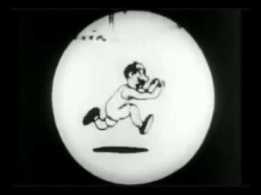
hqdefaultThe six-minute long Eveready Harton in Buried Treasure (1928–1929) was among the very first animated porn films. The main character’s expansive penis escapes his body, hides behind rocks, functions as a third leg, gets attacked by a plate-sized crab louse during penetration, gets stuck in a man’s anus, bents, is hurt by cacti and licked by a cow. The film is rife with puns, bodily metamorphoses and hyperbole while the boundaries of the animate and the inanimate, human and animal, are in constant flux. As José B. Capino (2004) points out, “just as animals, plants and humans communicate and play with each other in mainstream animation, so also do the figures in animated pornography speak the same language of polysexual desire and perform more sexual roles than conventional human morality can tolerate” (p. 59).

A series of German, undated Super 8 film loops dating back to the early 1970s revisited classic fairytales and cartoons – from the Western adventures of Puffalo Bill to Robert Keller und Dieter Hahn where Max and Moritz play out some of their more adult tricks, Rammel der Hase featuring an amply endowed Bugs Bunny of sorts, Schneeflittchen und die 7 Zwerge where Snow White engages in group sex with the seven dwarfs and shoots pickles from her vagina and Schwänzel und Gretel (also known in English as Dickzel and Gretel and Hans and Gretel in the Magic Forest), where penises grow from the ground and people, squirrels, owls and pigs all engage in continuous orgies (Capino, 2004, p. 57). The films’ pornographic fantasylands are ones of excessive, even compulsive sexuality where ejaculate oozes from unsuspected outlets and lubricates the narrative action. All these cartoons aim to titillate through their sexual explicitness but much more centrally to entertain through their surprising twists and unequivocally smutty forms of humour.

Animated porn has since taken virtually endless shapes and forms, from parody versions of popular children’s animation gone wild to fan-made machinima created out of The Sims and the 3D, high-resolution bodies approximating photorealistic aesthetics and representing the higher end in production values. Alongside these, all kinds of pornographic comics and still images abound in resolutions high and low, in genres more and much less mainstream and in aesthetics ranging from the cartoonish to the photorealistic. The pleasures involved in the processes of modelling bodies and acts, as figures of fantasy, is key motivation for the often unpaid, voluntary and hobbyist labour that the crafting of monster cartoon porn requires. In Tiziana Terranova’s (2004) terms, “they witness an investment of desire into production of the kind cultural theorists have mainly theorized in relation to consumption” (p. 84).

Digital image manipulation and animation tools have grown increasingly accessible, and the outcomes ever more available on online video sharing platforms. Aggregator sites enable the uploading, and hence the public archiving, of clips that were previously in much narrower circulation through screenings, VHS and DVD compilations. The “affective processing” of “digital ephemera” (Gehl, 2011) on tube sites gives rise to heterogeneous archives of varying copyright statuses. Individual clips are detached from their original contexts of production and distribution, titled, described and tagged as users see fit (Gehl, 2009, p. 46–47). In these horizontal archives, one may move from Pokémon hentai featuring some of Pikachu’s more raunchy moments to the pornographic variations of Family Guy, Simpsons and Futurama where family members get it one with one another and the boundaries of species, as well as those of humans and machines, are overcome with gusto.

The tentacled dynamics of hentai

In Japanese, the term hentai refers only to sexual materials deemed unusual, extreme or abnormal. Such scenarios might involve “number of partners as in gang rape, or bizarre partners as in aliens or monsters or illicit partners as in children” (McLelland, 2006). Yet, despite referring to sexual depictions of the more extraordinary and unlikely kind, hentai lacks pejorative connotations similar to those of abnormality and perversion in Western countries (McLelland, 2006). It should also be noted that Japanese pornographic anime also more broadly involves streaks of “the fantastic, the occult, or science fiction” and privileges “the female body in pain” in scenes of sexual torture and mutilation (Napier, 2005, p. 64). This also applies to eroge, hentai computer games with their perennial – and perennially controversial – themes of incest and sexual violence (Martinez & Manolovitz, 2010).

While hentai was considered too extreme or plain bizarre for Western pornographic DVD markets of the 1990s, it quickly gained ubiquitous recognizability on online platforms, followed by broad, multi-platform distribution (Dahlqvist & Vigilant, 2004). Mariana Ortega-Bena (2009) defines hentai through characteristics such as “substandard animation, ample dwelling on unconventional erotic practices, a fixation on rape and nonconsensual sexual violence, and often preposterous scenarios” (p. 20), but also associates it with the grotesque and carnivalesque features of Japanese erotic fiction. Building on the tradition of shunga, erotic woodblock prints, which peaked during the Edo period (1603–1868), hentai richly features many of its themes, such as “Massive genitalia, ingenious sexual aids, couplings of all kinds, a wide array of fetishes, bizarre viewpoints, physical anomalies, bawdy comedy, and satirical vignettes” (Ortega-Bena, 2009, p. 20). The influences of shunga remain evident in hentai, from exaggerated physical characteristics to humour and elaborate scenarios of tentacle rape (Screech, 2009; Buckland, 2010; Gerstle & Clark, 2013; Kazutaka, 2013; Napier, 2005, p. 21).

The uses of tentacles and other non-human phallic shapes owes partly to Japanese legislation banning the showing of genitalia without pixelation (Hambleton, 2015; Napier, 2005, p. 79). The landscape of monster toon porn is similarly populated by tentacle 680px-Tako_to_ama_retouchedcreatures owing to Hokusai’s classic woodcut, The Pearl Diver (aka. The Dream of the Fisherman’s Wife, 1814) – as well as a vast range of giant worm-like creatures, demons, centaurs, elves, ogres, dragons, zombies and amalgamations of humans and bugs. Like hentai, monster toons are rife with “demonic phallus incarnate”: demonic characters that are “preternaturally huge, covered with rippling muscles, and inevitably equipped with an enormous penis (and often with phallic tentacles as well)” (Napier, 2005, p. 65, 79). Be these monsters insects, spiders, fishes, slugs, extra-terrestrial creatures or demons, action focuses firmly on vaginal, oral and anal penetrative sex that climaxes in money shots as monsters of all kinds sport highly anthropomorphic penises.

The sexual scenarios are overwhelmingly ones of domination and submission, often of the non-consensual sort. Monsters three times the size of elves slip excessively sized penises into mouths, anuses and vaginas while human-like bodies bend, flex and accommodate. It is generally female bodies – young, fit, beautiful and firmly humanlike as they tend to be – that are pushed to their boundaries of physical endurance by the sheer size of the penises, tentacles or objects inserted in their cavities.

A search for “monster toon” on Pornhub, world’s leading porn aggregator site, result in 5–6 minute clips with titles such as “Giant Monsters Take Hot Chick” and “Monster Sex on Space Station”. In these, sex acts consist of the same motions repeated over and over again, accompanied by the same facial expressions and sounds, or the lack thereof. The bodies of monster toon porn move back and forth in their penetrative acts with notably little variation in gesture or motion. On the one hand, these scenarios are markedly affective in their visceral attention to (more or less fantastic) bodily detail and in the dynamics of disgust, amusement and sexual arousal that they aim to evoke. On the other hand, the monsters and their more or less human partners are regularly affectless in their machinic bodily movements.

In terms of aesthetics, monster toon porn ranges from high-resolution visuals aiming at full photorealism to examples of much lower technical execution. In most instances, female characters tend to resemble the Realdoll brand of sex dolls in their plastic, ultra-feminine human likeness and functional purpose. In still images, the details of bodies are carefully crafted towards a paradoxical sense of verisimilitude, from the pores of the skin to the gradations of the soft, hard and the liquid while the bodies of machinima videos tend to remain much more sketch-like.

As is the case with Realdolls, the animated characters’ facial expressions are vacuous. Verbal output remains limited to the repetitive loops of grunts, sighs, squeals and whimpers that are largely detached from the motion of bodies, mouths and faces. Human voice functions as both an extension and displacement of the animated body (Capino, 2004, p. 64) and yields both distance and grains of proximity. According to Ortega-Bena (2009), hentai follows the more general trend of emotional inexpression and visual blankness in Japanese arts and film in that there is little explicit or outward expression of emotion. All this results in layers of spectacle and excess, blankness and impassiveness that are deployed in conveying the markedly fantastic and out-of-the-ordinary (Ortega-Bena, 2009, p. 20–21). Ortega-Bena sees the bodies of hentai as constantly moving “between dichotomies of male, female; potent, impotent; demonic, human; oppressive, submissive; possessive, possessed; attacker, attacked; sadist, masochist” that are nevertheless “ultimately fluid, can be shuffled around and are combined in a variety of ways” (p. 27).

Like hentai,  monster toon porn is posthuman in its hybrid protagonists that often metamorphose from one shape to another, in their computer-generated origins resulting from algorithmic functions and in their affectless bodies engaging in mechanical sexual acts. Although the boundaries of species are routinely crossed, bodies metamorphose from one form to another and novel incarnations are common, gendered lines of control nevertheless remain much more tenuous. Despite the unlimited possibilities that animation affords in imagining characters engaging in acts impossible for actual human bodies to accomplish, or even survive, the fantastic scenes of monster toon porn are regularly bound up with highly predictable ways of imagining both sexual scenarios and gendered power dynamics.

Machinima is primarily amateur-made and a rough, “a bit ugly” (Douglas, 2014, p. 333) aesthetic is part of its charm. While machinima is predominantly shared on YouTube, sexually explicit clips circulate on porn tubes – both ones specialize in cartoon porn, hentai and machinima and “general purpose” aggregator sites such as Pornhub and XVideos. On these, videos of drastically varying technical execution compete for viewer attention: from rough-edged characters with repetitive, bouncy and jerky movements more suggestive of photorealism than conforming to its dictates to extensively worked fantasy scenarios dwelling in visual detail.

Shared online, 3D monster toon porn machinima is part of a broader ecology of DIY fan videos, mashups, remixes and parodies that results from both fan engagement with popular culture and the accessibility and increasing performance of digital production tools (see Ito, 2011, p. 51). Independent of the specific forms it takes, machinima filmmaking is centrally derivative: “audiences look forward to familiar game locations, quests, items, and game-generated characters being reinterpreted” (Falkenstein, 2011, p. 87). Machinima involves a resampling and reimagining of game characters and events, and this is also where a central part of its attraction lies. In the sexually explicit extensions of in-game events, female characters, from Lara Croft to the female cast of Final Fantasy, appear in elaborate scenarios with nonhuman or semi-human partners both originating from the game world and not.

Given that monster toon porn involves predominantly scenes of non-consent, it can be easily associated with toxic game culture, its patterns of male privilege and violent exclusion of women (see Consalvo, 2012; Apperley, 2015). These misogynistic overtones have been rendered particularly explicit since the 2014 Gamergate controversy, which involved extensive harassment, shaming, threatening and silencing of women and minorities in game journalism, industry and scholarship (see Chess & Shaw, 2015; Massanari, 2015). Examined in this framework, the appropriation of female game characters in monster porn, no matter how strong and proactive they may be in their respective game worlds, is an extension of the broader gendered dynamics of game culture.

Fantastic bodies

Monster toon porn is basically the work of algorithms and a means of exploring sexual scenarios impossible to physically act out without censure or bodily harm (also Hernandez, 2005). In the realm of computer-generated still images, comics and videos, impossible embodiments and brutal scenarios abound. A Google image search for 3D porn comics generates top hits on incest fantasies where minors sport massive genitalia and taboos function as key incentive for action. As in literary pornography (Marcus, 1964), bodily capacities and desires know no bounds: this is a realm of unlimited and unbridled sexual opulence that no mundane routines or chores disturb.

Animation allows for constant metamorphoses of its “unreal, imaginary, fabricated, virtual” bodies (Capino, 2004, p. 53–54) that are unburdened by gravity, causality or the limits of what physical human bodies can do, or be. In addition to bodies fantastically bulging without tearing, bursting or bleeding, their insides can be rendered visible. The motions of penises seen through a woman’s body are a specific focus of interest in hentai. These are visualized through small vignettes revealing the motions of the penis inside the body, under the woman skin, flesh and muscle. Alternatively, bodies suddenly grow transparent in order to illuminate the action within. Here, the horizons of expressive and imaginary possibility of animation, such as exaggerated gestures, hypertrophied bodies and extreme doses of violence (Capino, 2004, p. 56), meet the excessive and hyperbolic features of pornography.

“Of the many tongues through which pornography speaks the unspeakable, animation is arguably the most articulate and audaciously vulgar. Within the vast corpus of pornographic cartoons, animated bodies can perform every desire and fantasy that the human body cannot utter. Relentlessly and with impunity, the animated bodyʼs plastic genitalia and invulnerable orifices grow and multiply, mutate and mutilate, probe or are penetrated by every imaginable object and animal. Sexual boundaries assume the solubility of water colors.” (Capino, 2004, p. 54.)

In hentai and ero manga (adult comics), the human body is regularly pushed to the extremes, even to “the point at which it can be no longer recognized as human” (Shamoon, 2004, p. 87). As Capino (2004, p. 58, 67) points out, there is a limitlessness of fantasy to animated pornography that often meets excessive punitive violence as bodies are mutilated or even annihilated. At the same time, these hyperbolic scenarios of excessive penetration, climax and lust involve plentiful instances of humour that is easily downplayed or even ignored when considering their gendered dynamics of submission and domination. Such instances may vary from the overall absurdity of the settings to the details of the action: winged creatures pounding tiny female bodies with their rainbow-hued penises that, impossibly, fit into the orifices where they are thrust.

The members-only website, Hellywood: Evil Invasion, specializes in glossy, carefully rendered and hyperbolic 3D still images of female celebrities – from Jessica Alba to Lindsey Lohan, Jennifer Aniston and Kate Perry – engaging in elaborate sexual acts with monsters of all kinds. Characterised as celebrity mansion where “a total fucking madness gets a whole new meaning”, Hellywood envisions:

“Shocking action-packed 3D hentai scenes of evil creatures from Hell fucking you (sic) favourite award-winning celebrities! Watch hottest women on Earth power-fucked my merciless invaders and gets (sic) orgasm from ugly cock fucking jaw-dropping hentai 3D fantasy scenes right now!”

hellyThe female celebrities’ faces have been appropriated from mainstream media images – film shots, magazine poses and music video stills – and their expressions range from surprise to disgust, enthusiasm, startle, dismay, joy and panache. The heads often fail to match the bodies modelled for them, many of which come with hyperbolically tiny waists and huge breasts. A legion of computer-generated demons, aliens and other monstrous creatures in greys, greens, blues, blacks and browns is seen probing the celebrities with their perpetually hard penises.

It does not take a huge stretch of analytical imagination to associate the gaping cavities, phallic shapes and metamorphosing bodies of monster toon porn, or the tentacled glossy parallel universe of Hellywood more specifically, with the notion of the grotesque, as introduced by literary scholar Mihail Bahtin in his study of Rabelais. For Bahtin (1984, p. 30–31, 317), grotesque represents the opposite of classic body ideas as limitlessness where the insides and outsides of bodies refuse to be confined within their regular boundaries. The aesthetics of the grotesque intermeshes with and immerses in bodily orifices, exaggerates and in resistant to moderation (Bahtin, 1984, p. 303–304), hence breaking against any conventional notions of proper taste or appropriate demeanour. While carnevalesque excess and unruly laughter are, with Rabelais, connected to the undoing of cultural hierarchies and positions of power, such a symbolic reading is less readily achieved with monster toon porn. Grotesque aesthetics are in broad use and moments of dirty humour abound yet these do not add up as symbolic subversion of social hierarchies of power. All in all, monster toon porn – like pornography more broadly – remains resistant to most readings aiming to pin it neatly down as a cultural symbol or symptom (see Paasonen, 2011).

Humour has been key elementary to the traditions of graphic pornography preceding film, pornographic animated film, comics as well as shunga and hentai that monster toon porn builds on. For her part, Ortega-Bena (2009) highlights the role of humour as adding to the pleasures of hentai and the sense of distance that its emotionally vacuous and expressionless characters create. Much of this applies to Hellywood where facial expressions are frozen in still motion, recombined with computer-generated bodies, smoothed over and set in elaborate scenes of monster orgies. These images are colourful and high-definition, and a great deal of attention has been paid to detail. The resulting effect of follows Capino’s (2004, p. 56) more general account of animated porn’s impossible, hyperbolic sexual activity as “multiplied in volume, exaggerated in magnitude”.

The Hellywood effect is literally too much: tongue-in-cheek inasmuch as sexually explicit. The site is richly garnished with invitations to see “Goblins, walking dead and disgusting creatures of ancient saga invade the Earth to nail every fuckable celeb in the area!”; “Gape on tight celebrity pussies getting ripped by dreadful cocks and filled to the brim with hot infernal seed!” and “Watch hell-born vile creatures fuck hot celebrity chicks into complete prostration!” Such enthusiasm towards evil creatures ripping and nailing hot chicks follows the vocabulary of hardcore porn that attaches unequivocally positive value to the dreadful, vile and disgusting as markers of no holds barred action (Paasonen, 2011, p. 57–59, 207–209). The huge monsters and tiny elves of monster porn further follow the guiding pornographic principles of spectacularly binary depiction of embodied differences, submission and control. The rhetoric of hardcore porn draws firmly on the juxtaposition of the tiny and the colossal, the degenerate and the sweet while firmly amplifying differences in gender, age and ethnicity for the ultimate effect. (Paasonen, 2011, p. 126–128, 157; Capino, 2004, p. 56.) In monster toon porn, this hyperbolic modality grows highly literal as the tiny is truly miniscule and the colossal simply gargantuan.

The dramatic, exaggerated and markedly unrealistic scenes and bodies of monster toon porn seem to provide antitheses for amateur pornography, the popularity of which has been a megatrend in for the last decade. If amateur porn draws its appeal from a sense of realness, recognisability, familiarity and authenticity, monster toons provide unreal, fantastic and alien scenarios. Meanwhile, its mechanical and machinic motions of bodies pushing back and forth without a great deal of expression, affective nuance or modulations in intensity come across as hyperbolic version of repetition central to pornography as a popular genre. All in all, monster toon porn remains notably resistant to literal interpretations based on the premises of realistic representation.

The heightened sense of fantastic, impossible unrealness, combined with the applications of photorealism, explains much of the appeal of 3D monster toon porn: its phallic excessiveness is simply impossible to ignore. While immersion in its imageries is undoubtedly possible, a more literal identification with its emotionally vacuous characters is more unlikely. Violent scenarios of submission and control are played out to the fullest, often on overdrive, yet as void of affective intensity. The resonances that they afford are distinct from those of live-action pornography where the effects of bodies whipped, asphyxiated and stretched are bound up with a visceral sense of indexicality – be this experienced as titillating, disturbing or both. In contrast, fantastic computer-generated bodies are endlessly pliable and resilient, perfectly symmetrical, smooth and fine-tuned. They stretch, bounce right back and never fail.

References:

Adelman, B. (1997). Tijuana Bibles: Art and wit in America’s forbidden funnies, 1930s–1950s. New York, NY: Simon & Schuster.

Apperley, T. (2015). Gaming’s secret public: Nerdcore porn, #gamergate and the in/visible body of the female gamer. Presentation at the Adult Play seminar, University of Tampere, May 11–12, 2015.

Bahtin, M. (1984/1965). Rabelais and his world. Trans. Hélène Iswolsky. Bloomington, IN: Indiana University Press.

Buckland, R. (2010). Shunga: Erotic art in Japan. London: British Museum Press.

Capino, J. B. (2004). Filthy funnies: Notes on the body in animated pornography. Animation Journal 1, 53–71.

Chess, S. & Shaw, A. (2015). A Conspiracy of fishes, or, how we learned to stop worrying about #GamerGate and embrace hegemonic masculinity. Journal of Broadcasting & Electronic Media, 59(1), 208–220.

Consalvo, M. (2012). Confronting toxic gamer culture: A challenge for feminist game studies scholars. Ada: A Journal of Gender, New Media & Technology, 1(1), http://adanewmedia.org/2012/11/issue1-consalvo/?utm_source=rss&utm_medium=rss&utm_campaign=issue1-consalvo.

Dahlqvist, J. P. & Vigilant, L. G. (2004). Way better than real: Manga sex to tentacle hentai”. In D. D. Waskul (Ed.), Net.seXXX: Readings of sex, pornography, and the Internet (pp. 91–103). New York, NY: Peter Lang.

Douglas, N. (2014). It’s supposed to look like shit: The Internet ugly aesthetic. Journal of Visual Culture, 13(3), 314–339.

Falkenstein, J. (2011). Machinima as a viable commercial medium. Journal of Visual Culture 10(1), 86–88.

Gehl, R. (2009), YouTube as archive: Who will curate this digital Wunderkammer? International Journal of Cultural Studies, 12(1), 43–60.

Gehl, R. W. (2011). The archive and processor: The internal logic of Web 2.0. New Media & Society. 13(8), 1228–1244.

Hambleton, A. (2015). When women watch: The subversive potential of female-friendly pornography in Japan. Porn Studies, published online before print.

Hernandez, P. (2015). The people who make brutal video porn. Kotaku, 11 March, http://kotaku.com/the-people-who-make-brutal-video-game-porn-1690892332.

Ito, M. (2011). Machinima in a fanvid ecology. Journal of Visual Culture, 10(1), 51–54.

Kazutaka, H. (2013). No laughing matter: A ghastly shunga illustration by Utagawa Toyokuni. Japan Review, 26, 239–255.

Klein, N. M. (1993/1998). 7 Minutes: The Life and Death of the American Animated Cartoon. London: Verso.

Marcus, S. (1964). The other Victorians: A study of sexuality and pornography in mid-nineteenth-century England. New York, NY: Basic Books.

Martinez, M. & Manolovitz, T. (2010). Pornography in gaming. In D. Riha (Ed.), Videogame Cultures and the Future of Interactive Entertainment (pp. 65–74). Oxford: Inter-Disciplinary Press.

Massanari, A. (2015). #Gamergate and the fappening: How Reddit’s algorithm, governance, and culture support toxic technocultures. New Media & Society, Published online before print October 9, 2015, doi:10.1177/1461444815608807.

McLelland, M. (2006). A short history of ‘hentai’. Intersections: Gender, History and Culture in the Asian Context, 12, http://intersections.anu.edu.au/issue12/mclelland.html.

Napier, S. J. (2005). Anime from Akira to Howl’s moving castle: Experiencing contemporary Japanese Animation. Updated edition. New York, NY: Palgrave.

Ortega-Brena, Mariana (2009), Peek-a-boo, I See You: Watching Japanese Hard-Core Animation. Sexuality & Culture 13: 17–31.

Penley, Constance 2004. Crackers and whackers: The white trashing of porn. In Linda Williams (Ed.), Porn studies. Durham, NC: Duke University Press, 309–331

Pilcher, T. (2008). Erotic comics: A graphic history from Tijuana Bibles to underground comix. New York, NY: Abrams.

Screech, T. (2009). Sex and the floating world: Erotic images in Japan 1700–1820. Second Edition. London: Reaktion Books.

Shamoon, D. (2004). Office sluts and rebel flowers. In L. Williams (Ed.), Porn Studies (pp. 77– 103). Durham, NC: Duke University Press.

Terranova, T. (2004). Network culture: Politics for the information age. London: Pluto.

Todd, C. (2015). GamerGate and resistance to the diversification of gaming culture. Women’s Studies Journal, 29(1), 64–67.

Uidhir, C. M. & Pratt, H. J. (2012). Pornography at the edge: Depiction, fiction, and sexual predilection. In H. Maes & J. Levinson (Eds.), Art & Pornography: Philosophical Essays (pp. 137–157). Oxford: Oxford University Press.


Leave a comment

Filed under cultural studies, porn studies

childhood porn memories

It’s been fun working on the memory-work materials on Finnish people’s experiences and memories of porn, collected in 2012, but that project is now done. My last actual research article on this, titled Bad education? Childhood recollections of pornography, sexual exploration, learning and agency in Finland, written together with the marvellous Sanna Spišák, is just out with the journal Childhood. Many nostalgic memories there, and notably few mentions of trauma. Read it here if the mood strikes you. And here’s the abstract:

“This article draws on a memory-work project on the childhood experiences and memories of pornography in Finland to argue that the autobiographical younger self used in these reminiscences is a creature distinct from the cultural figure of a child at risk, and that the forms of learning connected to pornography are more diverse and complex than those limited to sexual acts alone. The notion of an asexual child susceptible to media effects remains detached from people’s accounts of their childhood activities, experiences and competences. By analyzing these, it is possible to critically reexamine the hyperbolic concerns over the pornification and sexualization of culture.”

Leave a comment

Filed under cultural studies, media studies, porn studies