
Late spring turns out to be full of interesting conferences, from The Public Spheres of Resonance: Constellations of Affect and Language in Berlin, April 27-29 to The Digital Everyday: Exploration or Alienation? in London, May 6 and Sexualities and Digital Culture in Europe in Athens, May 26-27. See you there, there and there, perhaps, plus at the Click Festival in Elsinore, May 20.
Category Archives: internet research
briefly on Pornhub’s PR campaigns
This spring, I’m mainly working on the #NSFW book with Kylie Jarrett and Ben Light, which is due out in 2018. Both exploring the uses of the tag and considering the intersections of sexuality, social media, labour, risk and safety from multiple perspectives, the book also focuses on the role and position of porn in social media. Below is a brief excerpt addressing Pornhub’s publicity campaigns, with less of the scholarly debates and some of the links included.
Branding porn SFW
 In February 2015, Pornhub announced that they were developing a wearable device titled Wankband that lets users charge their smart devices with the kinetic energy generated through the up and down motions of male masturbation:
“Every day, millions of hours of adult content are consumed online, wasting energy in the process and hurting the environment. At Pornhub we decided to do something about it. Introducing the Wankband: The First wearable tech that allows you to love the planet by loving yourself.”
Producing of 100% renewable “guilt-free electricity,” Wankband is part of a longer chain of publicity campaigns through which Pornhub has been profiling its brand and services as fun, user-friendly, socially responsible, and risk-free. The general mode of these PR campaigns might, in British English, be defined as “cheeky,” namely witty bordering on the rude and the irreverent. These campaigns can be divided roughly into three categories: publicity stunts, social and environmental causes contributed to under the rubric “Pornhub Cares,” and “Pornhub Insights” which, similarly to “Google Trends,” consist of statistics and infographics detailing site traffic and user trends.
 Pornhub’s publicity stunts have included the 2013 SFW television advert featuring a senior couple sitting on a park bench accompanied by an R&B tune. According to the company, it was intended for Super Bowl but got rejected by CBS, yet this seems highly doubtable on the basis of the advert’s low production values alone. In 2014, Pornhub announced an open SFW advertising contest encapsulating its brand. The crowdsourcing call attracted some 3,000 submissions and the winning entry, along with the shortlisted proposals, were widely covered in online news forums and clickbaits well beyond platforms considered pornographic. The winning ad poster, designed by the Turkish copywriter, Nuri Gulver, and titled “All You Need is Hand,” was briefly erected on the iconic location of Times Square to the backing vocals of Gotham Rock Choir’s rendition of the Beatles classic, All You Need is Love. The same year also involved a contest for Pornhub theme song and the offer of free premium memberships on Valentine’s Day.
In 2015, the company announced its plans for shooting the first pornographic film in space, provided it would be able to collect the necessary $3.4 million budget through crowdfunding: these plans were report in The Huffington Post, The Express, Times of India, The Mirror, and on CBNC, among other mainstream news outlets. News of these stunts, some of which are more fake than others, travel quickly in social media by virtue of their easy combination of humor, pornography, and user engagement. The stunts invite users as participants not only in porn consumption and masturbation but equally in Pornhub brand building and the funding of its productions.
Pornhub’s social causes and charitable campaigns have ranged from the “Save the Boobs” campaigns collecting money for breast cancer research on the basis of the videos viewed in its “big tit” and “small tit” categories to the 2014 campaign, “Pornhub Gives America Wood,” which involved planting trees for every 100 videos watched in its “Big Dick” category, and the 2015 “Save the Balls” testicular cancer awareness campaign. In 2015, the company gave out its first $25,000 scholarship for academic studies on the basis of the candidates’ videos detailing how they strive to make others happy. The following year, the scholarship was given for women studying science, technology, engineering, or math, with the aim of advancing women’s careers in the tech industry. In addition, Pornhub has joined in a campaign for saving sperm whales and, together with porn star and intimate partner violence victim Christy Mack, has set out to fight domestic violence.
Information on these campaigns, with their more or less tangential connections with pornography, travels through news hubs, blogs, Twitter, and Facebook. The stunts also circulate in these forms but fundamentally revolve around the relation between Pornhub and its users and serves in the construction, management, and maintenance of a brand community. The social causes, on the other hand, are additionally focused on constructing Pornhub as a socially responsible—and in this sense, respectable—corporate brand that contributes to making the world a better place, even if the sums involved in its charitable campaigns are on the modest side.
In Feburary 2017, Pornhub launched their “Sexual Wellness Center,” a sex education site with information on reproductive health, STDs, and relationships. The role of pornography as a form of sex education has long been a topic of debate among educators, journalists, academics, and concerned adults: in most instances, porn is firmly seen as bad in its pedagogical output and the false, exaggerated, and generic sexual scenarios that it reiterates. By inserting the professional angle of sex education into their palette of free service, Pornhub aims to further bolster its image of public responsibility. At the same time, news of the sex education site’s launch gained the company ample free—and largely positive—publicity across the platforms of social media.
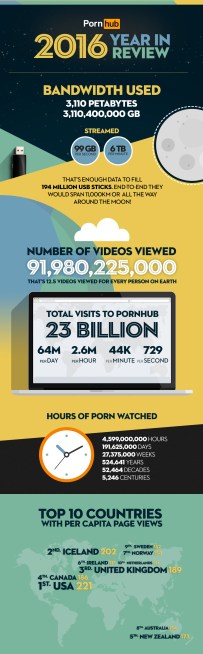 Probably the most successful form of the company’s PR campaigns nevertheless involves “Pornhub Insights,” its widely circulated and diverse user statistics and infographics, most notably those published in its annual “Year in Review.” From these data, news media pick up on the sheer volume of traffic on just this site: in 2016, there were a reported 23 billion visits resulting in 4,6 billion hours spent watching 92 billion videos. The annual reviews summarize web site traffic, search behaviors and trends, use patterns, devices used, and breaks down this data according to search terms and lengths of visits in different countries. In its stickiness, such data is understandably attractive to international online news sites and blogs wishing to catch the fleeting attention of users and its already digested, easily understandable forms further fuel its spreadability. Given the general, and notorious, shortage of any reliable data on the patterns of online porn consumption, Pornhub statistics are, despite their specificities, shared and referenced broadly as evidence of porn trends on a global scale.
The width and depth of the user data analyzed and visualized in the Pornhub’s annual review and their multiple monthly thematic reports makes evident—and in fact notably graphic—the flows of user data that are automatically generated and stored when accessing video aggregator sites or virtually any other website. Sites collect data on the devices and operating systems used, clicks, searches, comments, and connections made, archive, mine, and analyze this data for the purposes of targeted advertising. Pornhub’s manner of re-circulating and feeding back this data to consumers may be exceptional in its degree of detail, yet, there is nothing exceptional in their access to, or uses of the data as such.
Cutting through Pornhub’s PR efforts is the aim of overcoming the boundary between things deemed suitable for mainstream social media platforms, and those not. The campaigns afford Pornhub broad, positive international publicity in news sites and social media platforms for virtually no expense. Facebook, for example, allows sharing of news items on Pornhub but no links to the site itself. It would be highly unlikely for most news sites covering their PR stunts to accept the company’s advertisements should these ever be proposed but they cover the company’s stunts and projects with glee in search for clicks, reactions, and shares that function as indicators of attention. Pornhub’s PR stunts are, in sum, perfectly attuned to the click economy of social media: they feed clickbaits that again feed (and feed on) Facebook traffic in particular. This translates as added value to all parties involved.
By publishing the volume and trends of porn use on the site, Pornhub also makes claim for these practices being ubiquitous enough to form a quintessential part of the mundane rhythms and flows of media use across national boundaries during both working hours and leisure. This is a firm gesture of mainstreaming, of moving porn consumption from the so-called “dark” or marginal side of Internet use towards its central traffic and reframing it as a fun, recreational activity. Pornography has been part and parcel of the mainstream Web since its very early days, considering its perennial popularity among users and its centrality in terms of online economies, but has nevertheless retained a conceptual status as a marginal and somehow illegitimate of the medium. In this sense, Pornhub’s campaigns can be seen as contributing to a reframing of porn use by rendering explicit its mainstream and thus socially safe status. In a 2014 Adweek interview, Pornhub Vice President, Corey Price, explained that
“We want to push the conversation into the general public as something that’s acceptable to talk about, while letting people know that watching porn shouldn’t be an underground activity that’s to be seen as shameful. Everyone does it, why not just bring that out in the open? The reason it causes a stir is due to an already accepted set of social norms.”
The overall aim of the PR campaigns is to build up Pornhub as an entertainment brand among others. This again implies a process of domestication whereby media contents deemed unsavory, inappropriate, and off the mainstream are rendered familiar, acceptable, routine, and ordinary. Such processes have during the past decade or so, been diagnosed through concepts such as the sexualization and pornification of culture with the aim of accounting for how pornography has grown mundane in its accessibility, how people of different ages and genders are routinely consuming it, and the role that the flirtation with both the sexually suggestive and the sexually explicit plays media culture. Such diagnoses describe the mainstreaming of pornography in terms of its sheer popularity (bearing in mind the annual volume of Pornhub traffic alone), as well as the general visibility of pornographic codes, aesthetics, and themes across different fields of culture. As a long-standing media cultural trend, flirtation with pornography is telling of the perpetual—albeit also regularly uncomfortable—public presence of materials deemed obscene, the simultaneous fascination and aversion that they entail, as well as the constant labor involved in maintaining some kind of a boundary between pornography and the mainstream, the NSFW and SFW.
The mainstreaming and domestication of Pornhub through its SFW public relations campaigns interferes with the scent of forbidden fruit on which the cultural status, and central attraction, of pornography has been dependent throughout its history and which has rendered it the content that necessitates specific policing, censorship, and acts of regulation. Their PR campaigns increase the brand’s visibility in a range of SFW within the online attention economy of clicks, links, and shares, but similar cross-platform circulation cannot apply to the NSFW videos that the site hosts.
Filed under cultural studies, internet research, media studies, porn studies
sexualities and digital culture in Europe
The Gender and Communication and Digital Culture Sections of ECREA are jointly organising a symposium in Athens, May 26-27, on Sexualities and digital culture in Europe. With a focus on sexual experiences, practices and digital culture; intimate/sexual citizenship and the digital and online sexual content and representations, the event sets out to explore the “sexual politics, challenges, opportunities and continuities surrounding the digital, with a specific focus on European contexts:”
“We particularly welcome contributions on topical matters in European societies and politics, among which: the regulation of online pornographic content in discussions on sexuality, children and the internet, LGBTQ challenges and opportunities related to the digital, the rise of conservative grass-roots movements in Europe that protest against what is called ‘gender ideology’ (such movements question and protest pro-gender equality legislations, abortion laws, same-sex marriage laws and transgender laws, while advocating for traditional family values and ‘restoring’ the naturalness of male and female bodies).”
Proposal deadline is February 2. As keynote, I’m honoured, flattered and frankly anxious to be speaking to the range of issues raised.
Filed under internet research, media studies, porn studies
modes of un_relating
Should you be in Hamburg next week, please join us at the conference Loose connections: Modes of un-relating on January 12 and 13, organised by the PhD program, ‘Loose Connections: Collectivity in Digital and Urban Space.’ Talks include Michael Liegl on the meandering collectivity of Grindr, Ben Anderson on neoliberal structures of feeling and Graham Harman on loose relations. My thing on “Lagging proximities, ambivalent intimacies” draws on my recent work on the role that networked media, as infrastructures of everyday life, play in the formation and maintenance of intimacies.
.
Filed under cultural studies, internet research, media studies
distractions!
 Voilà, “Fickle focus: Distraction, affect and the production of value in social media,”one of the outcomes of my current research project on distraction, anxiety, boredom and other similarly happy affects connected with networked media, is very freshly out with First Monday’s Economies of the Internet special issue edited by Kylie Jarrett and Dylan Wittkower. Huge thanks to Kylie and Dylan, as well as Michael Petit and Tarleton Gillespie for the helpful comments and suggestions.
And here’s the abstract:
The uses of social media can be seen as driven by a search for affective intensity translating as moments of paying attention, no matter how brief these instances may be. In the framework of attention economy, attention has been discussed as a valuable commodity whereas distraction, involving both pleasurable entertainment and dissatisfactory disorientation, has been associated with cognitive overload and the erosive lack of focus. By discussing clickbait sites and Facebook in particular, this paper inquires after the value of distractions in and for social media. Understanding distraction, like attention, as both affective and cognitive, this article explores its role in the affective capitalism of clicks, likes, and shares. Rather than conceptualizing attention and distraction as mutually opposing, I argue for conceptualizing them as the two sides of the same coin, namely as rhythmic patterns in the affective fabric particular to the contemporary landscape of ubiquitous networked connectivity.
Filed under affect theory, internet research, media studies
more reviews for Networked Affect
It continues to be a thrill to get Networked Affect, which I co-edited with Ken Hillis and Michael Petit for MITP last year, reviewed and hence empirically read. So here’s Blake Hanninan with “The Internet of Feels” for Cultural Studies, Sonja Vivienne for Information, Communication & Society and Emma Baulch for Mobile Media & Communication.
Filed under affect theory, cultural studies, internet research, media studies
disquieting, unfit social bodies
Our book project, #NSFW, is moving more into the writing phase with Kylie Jarrett and Ben Light, which is exciting indeed. So here’s a little something towards for a section on nudity and social media.
***

On February 9, 2016, visual artist Illma Gore published a pastel pencil painting of Donald Trump in the nude, titled “Make American Great Again,” on her Facebook page with the accompanying slogan, “Because no matter what is in your pants, you can still be a big prick.”
Inspired by the highly public, and broadly discussed, allusions to Trump’s penis size during the Republican presidential primary debates, the drawing featured the candidate with genitalia of markedly modest size. The image soon began circulating on other social media platforms from Instagram to Tumblr, Twitter, and Snapchat. By February 11, it was featured with NSFW warnings in media outlets such as The Huffington Post (“Artist Imagines What Donald Trump Looks Like Naked And It Ain’t Pretty (NSFW)”) and The Daily Dot (“Realistic nude painting of Donald Trump will make you gouge your eyes out”), with many other stories to follow.
Very quickly after posting the initial image, Gore’s Facebook account was temporarily suspended for violating the service’s community standards, and it has been blocked numerous times since. According to these standards:
“We remove photographs of people displaying genitals or focusing in on fully exposed buttocks. We also restrict some images of female breasts if they include the nipple, but we always allow photos of women actively engaged in breastfeeding or showing breasts with post-mastectomy scarring. We also allow photographs of paintings, sculptures and other art that depicts nude figures. Restrictions on the display of both nudity and sexual activity also apply to digitally created content unless the content is posted for educational, humorous or satirical purposes. Explicit images of sexual intercourse are prohibited. Descriptions of sexual acts that go into vivid detail may also be removed.” (https://m.facebook.com/communitystandards/?section=1)
Illma Gore’s portrait of Trump in the nude did not in fact violate these terms as she had covered Trump’s genital area with a black block (Hoffman 2016). On March 3, she published an eBay listing for the piece, only to have it taken down a few days later due to violating the service’s policy on images of nudity, according to which “frontal nudity is allowed in Art categories when the item is considered fine art, such as Michelangelo’s David, vintage pin-up art, Renaissance-style paintings, and nude cherubs.” Works not fitting these parameters should be listed in the Adult Only Category. (http://pages.ebay.com/help/policies/adult-only.html.) Within a week, Gore had been threatened by lawsuits from Trump’s team and risked having her Facebook account permanently blocked. (Voon 2016.)
The image itself is well suited in terms of both news outlets and click sites in its visceral display of folding naked celebrity flesh. News items on the acts of blocking, banning, and potential censorship connected to it—and ones related to Facebook in particular—invested the incident with a different kind of sticky attention value. In the course of this all, the image gained notable virality as people shared news items, most of them featuring an uncensored version of the portrait (as seen above) that consequently found its way to extensive distribution on Facebook. In order to further fuel its dispersion, Gore put a high-resolution image file on her website for free downloading. By April 2016, the portrait was on display at the Maddox gallery in London, priced at £1m (http://www.theguardian.com/us-news/2016/apr/17/nude-donald-trump-painting-illma-gore-lawsuits). All this witnesses to the intermeshing of attention value and monetary value through and within the fast speeds of social media platforms, online news outlets, links, and clicks, as debated in the context of attention economy, even if this is not the key issue right here.
The image in question, situated in the realm of arts and politics alike, is one in a long, constantly accumulating stream of incidents testing and challenging the community standards of Facebook. At the same time, the incident is also somewhat exceptional in that it focused on the nude male body of a celebrity politician. Other controversies to date have predominantly focused on images of female bodies, as in the context of breastfeeding and breast cancer. In 2012, a group of women gathered in front of Facebook headquarters in a collective breastfeeding protest opposing their policy of flagging and removing images of nursing. In a 2013 controversy, over 20,000 people signed a Change.org petition protesting the removal of images of mastectomy as obscene (and hence as comparable to pornographic content). Facebook community standards have since undergone revisions. According to the March 2016 version,
“We also restrict some images of female breasts if they include the nipple, but we always allow photos of women actively engaged in breastfeeding or showing breasts with post-mastectomy scarring. We also allow photographs of paintings, sculptures and other art that depicts nude figures. Restrictions on the display of both nudity and sexual activity also apply to digitally created content unless the content is posted for educational, humorous or satirical purposes.”
Nudity occupies a tricky terrain in the borderlines between the SFW and the NSFW, especially since the criteria regulating obscenity are, due to the largest social media platforms’ country of origin, overwhelmingly defined according to standards particular to U.S. culture. Art remains a space where nudity fails to be automatically conflated with obscenity, yet terms of service routinely map out its confines and discontents in notably conservative terms. On eBay, this involves fencing off the obscene in contrast to Renaissance-style aesthetics and cherubs even while the normative boundaries of art are transgressed by including vintage pin-ups within the category. For its part, Facebook recognizes painting and sculptures but not digitally generated images as art, hence articulating the boundaries of art in highly medium-specific means.
Image recognition software has been developed since the 1990s for automatically filtering out pornographic images (e.g. Ries and Lienhart 2014; Iqbal et al. 2016), yet Gore’s blocked Facebook access most likely owes to other users reporting the image as offensive, and company representatives screening the content agreeing on the issue (cf. Summers 2009). As a mechanism for reporting offensive content, flagging, as “technical rendition of ‘I object,’” is based on user participation in the reification of social media sites’ community norms (Crawford and Gillespie 2014, 2, 5).
Kate Crawford and Tarleton Gillespie (2014, 2) show how flagging has become a ubiquitous mechanism of governance with a somewhat complex relation to community sentiment, consisting as it does of interactions between “users, platforms, humans, and algorithms, as well as broader political and regulatory forces.” These are themselves inseparable from moral concerns and corporate strategies, and routinely result in opaque decisions detached from broader negotiations or articulations of concern over what is acceptable, offensive, or controversial (Crawford and Gillespie 2014, 4, 10).
In another March 2016 incident, Mari Corry’s photo showing her breastfeeding in a park was flagged as offensive. In protest, she uploaded a breastfeeding photo where the baby’s head was covered with a print featuring a Victoria’s Secret Model, hence commenting on double standards concerning women’s breasts and the multiple purposes of their public visibility (Wallwork 2016). The previous month, Rowena Kincaid, terminally ill with breast cancer, uploaded a picture of her symptoms in order to help other women self-diagnose. Since the image included her nipple, it was soon flagged for violating community standards. She then reposted the image with a smiley drawn over the nipple. As was the case with Corry and Gore’s images, news of flagging fuelled the images’ social circulation across diverse platforms. Flagging is a sign of objection but it also involves more complex social dynamics and exchanges, many of which are inseparable from increases in attention value:
“Flags get pulled as a playful prank between friends, as part of a skirmish between professional competitors, as retribution for a social offense that happened elsewhere, or as part of a campaign of bullying or harassment—and it is often impossible to tell the difference. Flagging is also used to generate interest and publicity, as in the cases where YouTube put a racy music video behind an age barrier and promoters decried the “censorship” with mock outrage. The fact that flagging can be a tactic not only undercuts its value as a “genuine” expression of offense, it fundamentally undercuts its legibility as a sign of the community’s moral temperature.” (Crawford and Gillespie 2014, 11.)
The persistent hunt for offensive areolas and micro-penises in the incidents discussed above is connected to broader boundary maintenance between SFW and NSFW platforms. While Twitter, and Tumblr in particular, broadly accommodate sexually explicit content, most social media platforms undergo considerable effort to remove it. This, combined with the increased centralization of ownership to dominant actors (such as Google and Facebook), has drastically reframed the operating possibilities of companies trading in specifcially pornographic content. In his coverage of the adult app store, Mikandi, Wired reporter Cade Metz notes that
“with the rising power of companies like Apple and Google and Facebook, the adult industry doesn’t drive new technology. In many respects, it doesn’t even have access to new technology. The big tech companies behind the big platforms control not only the gateway services (the iPhone app store, Google Search, the Facebook social network) but the gateway devices (the iPhone, Android phones, Google Chromecast, the Amazon Fire TV, the Oculus Rift virtual reality headset). And for the most part, they’ve shut porn out. Besides, these giants now drive new technology faster than services like Mikandi or Pornhub ever could.” (Metz 2015.)
Porn sites—the market leader Pornhub being here an obvious example—are currently much more likely to emulate the technical solutions and revenue models of social media platforms than the other way around. Pornographic aggregator sites from RedTube to YouPorn and XTube have all copied their design and operating principles from YouTube. Meanwhile, those modelled after other social outlets, such as Fuckbook and Snatchly, “the Pinterest of Porn,” have not similarly picked up.
All this is in stark contrast to the situation some two decades ago, given the degree to which the needs of the porn industry drove the development of Web solutions. Gaming and online shopping only picked up towards the end of the 1990s, and for quite a while pornography remained one of the few forms of content that users would pay for. Consequently, safe credit card processing systems, streaming video technologies, and hosting services, as well as practices such as banner advertisement and pop-ups, were first developed for and used on porn sites. The role of porn as a driving force in dot.com enterprise has clearly since passed. While pornographic content still quickly migrates to new technical platforms and media formats, its position is crucially different in the context of social media than in the Web cultures of the 1990s.
Pornographic content, or even less sexually explicit nudity, is weeded out from platforms such as YouTube or Facebook through flagging and automated blocking alike : it is not possible to share links directly to pornographic content. Adult entertainment companies have public social media presence, yet this mainly involves sticking to the non-explicit and hence failing to represent the brands’ core features in order to accommodate diverse terms of service. In addition to key social media companies warding off pornography, Google, YouTube’s owner, also bans pornography from its advertisements:
“The AdWords policies on adult sexual services (…) will be updated in late June 2014 to reflect a new policy on sexually explicit content. Under this policy, sexually explicit content will be prohibited, and guidelines will be clarified regarding promotion of other adult content. The change will affect all countries. We made this decision as an effort to continually improve users’ experiences with AdWords.” (https://support.google.com/adwordspolicy/answer/4271759?hl=en&ref_topic=29265)
Search engines have long filtered our pornography from their freely published listings of most popular search terms, hence adding to the position of porn as a public secret of sorts. Search engines also filter out sexually explicit content in diverse ways, which, in practice, makes it difficult for users to find that which they are searching for. While this could, for evident reasons, be considered as deliberate design of a poorer service, such measures are articulated and motivated as improvements in user experience (as in the AdWords policy statement above).
Google has long provided a “SafeSearch” option that filters out all, or at least most, hits to adult content. As that which SafeSearch filters out, sexually explicit content becomes framed as unsafe and risky. Should the user choose to disable SafeSearch, Google will “provide the most relevant results for your search and may include explicit content when you search for it.” Searches on pornography can be openly tracked through Google Trends, witness to their perennial and even increasing popularity, yet without breaking down these trends into actual numbers of searches. All in all, the uneasy visibility of nudity and pornographic content in Web searches and on social media platforms speaks of a gap between the ideal, normative figure of a user—in accordance to which the services’ “community standards” are crafted—and the diverse interests, inappropriate interests, and unruly titillations of empirical, actual people that routinely veer towards the NSFW.
Filed under cultural studies, internet research, media studies, porn studies
 Susanna Paasonen