
There’s something quite virtual about academic publishing, with its slow tempos of putting things together, seeing books and journal issues slowly materialise and, in the best case scenario, having someone eventually read the thing. It’s therefore a thrill to have our Networked Affect, co-edited with Ken Hillis and Michael Petit, which only came out in the spring, being reviewed: by Sean McBean for New Formations. We have a reader.
Affected!
During my sabbatical year, I plan to do many many things, including lots of reading. In terms of writing, the plan is to work on a project tentatively titled “Affected: failure, distraction and network media” exploring the affective dynamics of network media through moments of failure, analyses of social media addiction and distraction and the pedagogical challenges that the ubiquity of social media poses in a media studies classroom. Some of this will happen together with the wonderful Michael Petit. More to follow.
Filed under affect theory
Girls and sexual role-play online
Based on Silja Nielsen’s excellent MA research involving a survey with 1269 Finnish female respondents aged 11–18, our article, “Pervy role-play and such*: Girls’ experiences of sexual messaging online, co-authored with Silja and Sanna Spisak, is now out with the Sex Education journal (online before print), as part of a special issue on the evolving role of media in sex education, edited by Alan McKee, Sara Bragg and Tristan Taormino. While providing an overview of the survey findings in general, the article is more focused on girls’ positive accounts of sexual role-play and messaging.
Filed under media studies, porn studies
Porn memories
The outcomes of our porn memory work project are finally materializing. In 2012, we asked together with the Folklore archives of the Finnish Literature Society for Finns of different ages to write to us about what they understand with porn and what kinds of materials, encounters with and experiences of porn they remember. Since the project never got funded, writing it up has not been speedy. But now! ‘We hid porn magazines in the nearby woods’: Memory-work and pornography consumption in Finland, written with Katariina Kyrölä, Kaarina Nikunen and Laura Saarenmaa and looking at the general methodology and findings, is available online before print with Sexualities. And that is not all: Glimmers of the forbidden fruit: Reminiscing pornography, conceptualizing the archive, written with the wonderful Katariina and exploring the different possibilities of archive as a concept in studies of porn use, is freshly accessible with the International Journal of Cultural Studies.
Filed under cultural studies, media studies, porn studies
A bit of porn scholarship – in Finnish
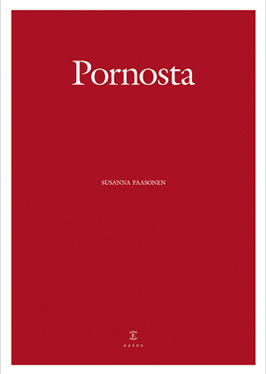 Just in case your language repertoire includes Finnish, here’s a bit of self-promotion for you. Pornosta, my short book on porn published by Eetos is out next week. And the report on the memory work project on porn, done in collaboration with the Folklore Archives of the Finnish Literature Society, titled “Siinä oli hämähäkki väärinpäin”, is already available here: https://www.doria.fi/handle/10024/103688.
Filed under porn studies
Networked Affect is out!
Based on a series of worksho ps at the 2011 Association of Internet Researchers conference in Seattle, Networked Affect is now out from MIT Press. Edited by Ken Hillis, Michael Petit and myself, it also includes essays by James Ash, Alex Cho, Jodi Dean, Melissa Gregg, Kylie Jarrett, Tero Karppi, Stephen Maddison, Jussi Parikka, Jennifer Pybus, Jenny Sundén and Veronika Tzankova. The book explores the intersections of internet research and theories of affect from a range of perspectives — from the queer reverbs of Tumblr to the gift economies of Facebook, nonhuman agencies of code, digital materialities of Steampunk and the political affect of Turkish sexual confession sites. So glad it’s finally out.
Filed under affect theory, media studies
affective encounters
Digging into my hard drive, there was the PDF of the proceedings for Affective Encounters: Rethinking Embodiment in Feminist Media Studies conference, held in University of Turku on 2001, coedited with Anu Koivunen. These went offline as the university once more redesigned their site – but are back now, here: proceedings.pdf.
Filed under affect theory, media studies
The affect of failure
For three years now, I’ve been asking my students to write a small essay on their experiences of media and communication technology failing – just describing how it feels – in order to address our mundane dependencies on technological devices and networks of different kinds. This tends to be a favorite assignment (these feelings can be stark) and makes teaching the basic ideas of ANT a little smoother in a humanities media studies classroom. The plan is to develop this line of investigation toward the affective underpinnings of network media more generally, with an emphasis on distraction, boredom and other similar happy states. But before I get that far (looking forward to the sabbatical next academic year!), an article of mine exploring some of these essays is freshly online with Television & New Media as “As networks fail: Affect, technology, and the notion of the user.” One of the most enjoyable experiences of working with an academic journal ever! Special thanks to Ken Hillis and Michael Petit for their thoughtful comments and feedback. To be continued.
Filed under affect theory, media studies
Examining a PhD dissertation in Finland: observations and tips
As my PhD examination spree for the spring is coming to a close, here are some observations and tips for those acting as opponents in Finnish doctoral defences in the humanities and social sciences.
1. When explaining the local specificities to opponents from other countries, I have compared the role of the opponent to the role of professional dancers in Dancing with the Stars: the opponent is the professional researcher who needs to come up with a choreography that makes it possible for the candidate – who is not yet quite professional – to show off her skills. This fails if the choreography is too easy but also if it’s too difficult. However, it’s crucial for there to be an element of challenge. It’s up to the opponent to ensure that this will be a good show. Choreography needs to match the skills of the candidate, as presented in the dissertation, and it’s performed together.
2. The examination is a public event with an audience, dress code and ceremonial lines to be delivered. It’s more formal than in most places. Not all members of the audience have read the work and not all of them work within the academia. Take the audience into consideration when formulating the opening statement (that can be descriptive) as well as when formulating your questions and discussing the work. Especially with questions of the more conceptual and theoretical nature, it’s good to explain where they’re coming from and why they’re being addressed. This helps the audience as well as the candidate.
3. Try to make the candidate speak more than you. Do not answer the questions for the candidate if she hesitates, and give her time to think before answering. You can always rephrase the question or present a follow-up question if the candidate finds your points hard to address.
4. The point of the examination is not to butcher the candidate – she is after all the star of the dance – but to discuss the work in order to evaluate how successful it is and what its merits are. Since candidates by default find the situation stressful, and since the opponent is called an opponent, questions may be interpreted as attacks even if their point is to discuss the decisions made. If possible, help the candidate relax and adjust your questions according to situation. Ideally, the defence provides a good debate.
Finally, select tips for the candidate:
- Read the evaluation criteria beforehand. This will give you a good idea as to what themes may be addressed. Be prepared to start with the title of the thesis and the central concepts it entails.
- If feeling nervous, write down the key points of your dissertation in order to recap them at some point during the examination.
- Avoid overt defensiveness. Do not dismiss any of the examiner’s questions. This easily comes across as arrogance, and is not desirable. Be open to discussion and debate.
- The examiner is an expert in the field but you know more about the research project discussed. Consider the defence as a possibility to discuss your work with a senior academic who has thoughtfully read it. For better or for worse, it’s unlikely that such an opportunity will repeat itself in the near future so take advantage. It’s your moment to shine.
And this is how formal it gets: http://www.utu.fi/en/research/dissertations/guidelines-for-the-doctoral-candidate/Pages/procedure-and-dress-code.aspx.
Filed under Uncategorized
 Susanna Paasonen